- Overview
- Legends
- History
- Architecture and the cave shrines
- Worship and customs
- Hymns and literature
- Nearby temples
- How to reach
- Festivals
- Photos
- Timings
- Questions
- Sources
Overview
The Subramaniya Swamy Temple at Thiruparankundram is a Murugan temple on the outskirts of Madurai and the first of the six abodes of Murugan (Arupadai Veedu), as listed in the Sangam text Tirumurugarruppadai. The five other abodes show Murugan standing, but here he is seated in a wedding pose with his consort Deivanai.[1][3]
The temple is built into a hillock and is a rock-cut cave temple. Dinamalar says five deities are housed in the one cave: Sathyagiriswarar (Shiva), Pavalakanivai Perumal (Vishnu), Karpaga Vinayaka, Subramaniar and Durga. It is also described as the only Arupadai Veedu temple where abhishekam is performed on Murugan's vel (spear).[3]
Because it also contains a Shiva shrine praised by the Tevaram saints, it is a Paadal Petra Sthalam, the third of the temples on the banks of the Vaigai according to Wikipedia.[1][2]
Legends
The wedding of Murugan and Deivanai
Murugan was born to defeat the asuras Surapadman, Simhamukhan and Tarakasuran. After his victory, Indra gave his daughter Deivanai to Murugan in marriage at Thiruparankundram, in thanks. Dinamalar says the wedding was attended by a large gathering of rishis, devas and gods.[1][3]
Murugan and the Pranava mantra
The TN Temples Project says Murugan once overheard Shiva teaching Parvati the Pranava mantra. Because knowing it through deceit is a wrong, Murugan sought pardon from Shiva here, and Shiva taught him its meaning on Thai Poosam day. Murugan is said to have worshipped Shiva here as Parangirinathar. Dinamalar says the Shiva shrine of Aadhi Sokkanathar marks where Murugan did penance for an error in learning the mantra, and is visited first by tradition.[2][3]
Nakkeerar and the spring
Dinamalar says the poet Nakkeerar was locked in a cave by a demon, sang the Tirumurugarruppadai, and was freed by Murugan. A spring is said to have then emerged from a rock, which is now the hilltop spring.[3]
Durga
After killing Mahishasura, Durga is said to have worshipped Shiva here to be relieved of the resulting sin. The Shiva form of the entire hill is named Parankundranathar.[3][2]
History
The Tirumurugarruppadai, a Sangam-era text attributed to Nakkeerar, names Thiruparankundram as the first of six Murugan shrines. Wikipedia says the temple was built by the Pandyas in the 6th century CE and is built in rock-cut style.[1][4]
Wikipedia also records that before the 6th century the Murugan shrine was converted into a Jain shrine by Jain monks under the Pandya king Koon Pandiyan, and returned to Hindu use in the latter part of the 8th century CE. The article does not reconcile these accounts, so the early history is flagged. It also notes two hilltop caverns with Tamil-Brahmi inscriptions dated to the 1st century BCE, which are uncited in the article.being verified[1]
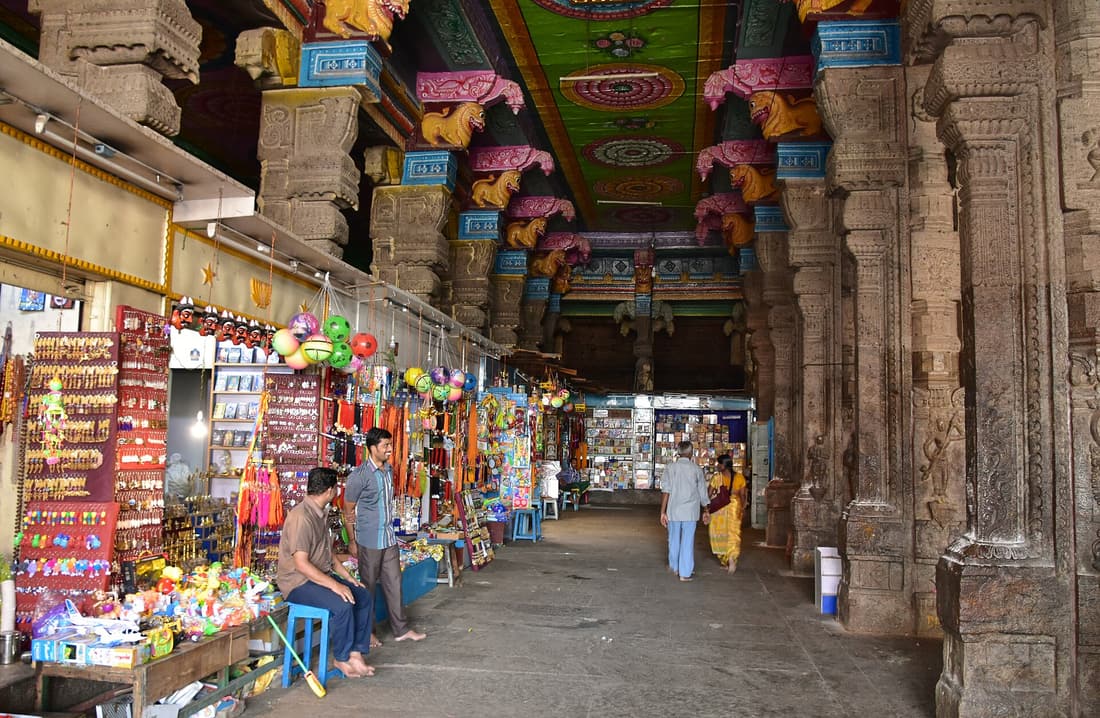
A 7th or 8th century CE rock-cut Shiva cave temple lies at the foot of the hill. The Madurai Nayaks added the pillared halls, with life-sized sculptures added in the 16th century.[1]
The TN Temples Project says the rock-cut temple was originally called Parankundram and stood at the rear of the present temple, and that after damage over time the shrines were moved to the front, facing north. Because the temple turned, the place came to be called Tirumbiya Parankundram, later shortened to Tiruparankundram.[2]
Architecture and the cave shrines
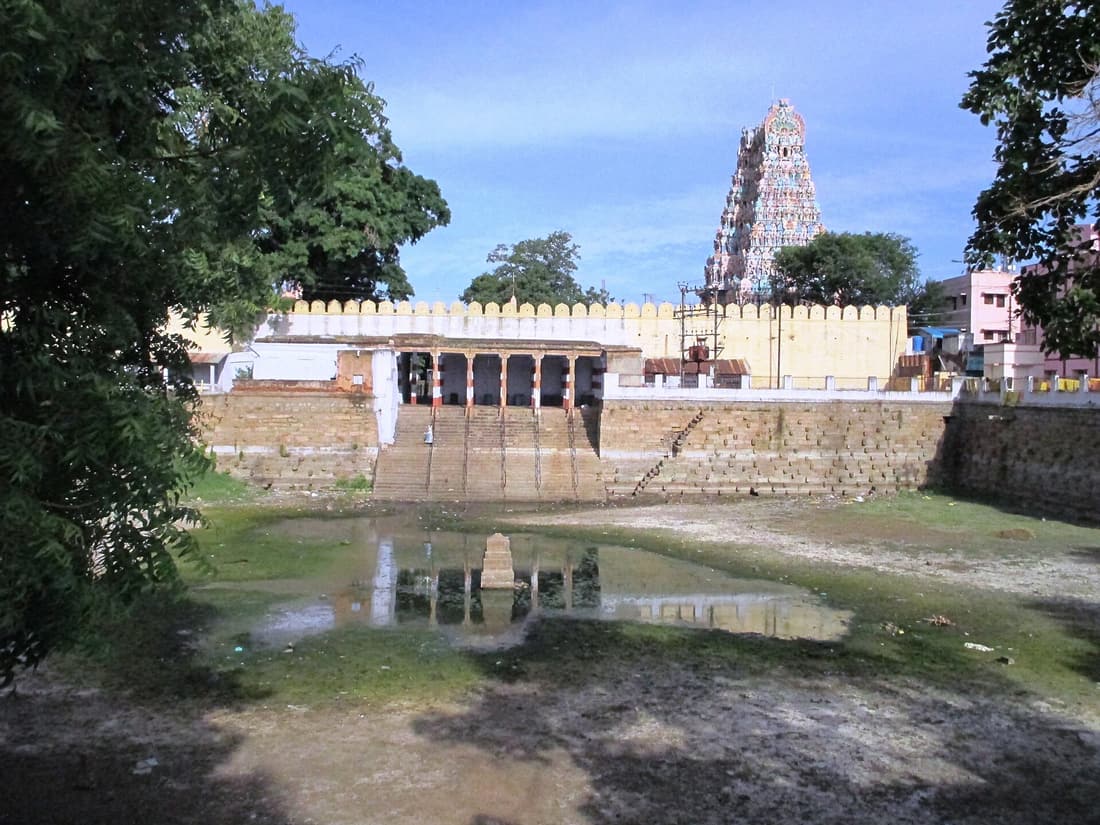
An Aasthaana Mandapam leads to a seven-tiered rajagopuram about 150 ft (46 m) high. The granite hill behind the temple is 1,050 ft (320 m) high, with the Kasi Viswanatha shrine at its top. Three halls at different levels lead to the sanctum: the Kambathadi, Ardha and Maha mandapams, and six steps called Shadashara Padigal lead to the Ardha Mandapam.[1]
The main shrine has cells for Murugan, Durga, Vinayaka, Shiva and Vishnu, all carved into the rock walls. Shiva and Vishnu face each other. Dinamalar says that because Vishnu is installed in Nandi's place, the temple is known as Mal Vidai. The Murugan image is said to be carved from a single stone.[1][3]
Rock carvings include Mahishasura Mardini, Karpaga Vinayagar, Andarabaranar and Uggirar, and statues of Nandi, the peacock and the mouse stand before the flagstaff. A Vedic school stands on the bank of the temple pond, where devotees feed the fish with salt and rice flakes.[1]
Water bodies: Wikipedia lists five (Saravana Poigai, Lakshmi Theertham, Saniyasi Kinaru, Kasi Sunai and Sathiya Koopam), while Dinamalar says the temple has 11 theerthas, including Saravana Poigai. The counts differ.being verified[1][3]
Worship and customs
- Wikipedia lists three daily pujas: Kalasanthi at 8:00 AM, Uchikalam at 12:00 noon and Sayarakshai at 6:00 PM, each with abhishekam, alangaram, naivedyam and deepa aradhanai. The same article's lead says six daily rituals, so the schedule is not certain.being verified[1]
- The Shiva lingam receives only oil, because it is coated with a paste called Shantakaram. Lamps are lit in the Durga shrine every day during Rahu Kala.[3]
- Devotees who face obstacles in marriage alliances or have concerns about their children pray here, and offer annadhanam (feeding the poor) as a vow. Rudrabhishekam is offered to Dakshinamurthy for relief from horoscope afflictions and prolonged illness.[3]
Hymns and literature
The Tirumurugarruppadai names Thiruparankundram first among the six shrines. The TN Temples Project lists Sambandar and Sundarar as the Tevaram singers for the Shiva temple, and Wikipedia says Sambandar praised the Shiva icon Uchinathar. Arunagirinathar's Tiruppugazh, a 14th-century work, also describes the shrine.[1][2][4]
Nearby temples
How to reach
- The temple is about 7 km from Madurai on the Madurai-Kanyakumari road (Dinamalar), or about 8 km (Wikipedia and the TN Temples Project). The nearest railway station is Thiruparankundram, Madurai, and the nearest airport is Madurai.[3][1][2]
- Accommodation of all budgets is available in Madurai. The TN Temples Project lists Virudhunagar 43 km and Dindigul 66 km.[2]
Festivals
Photos
Timings
- 5:30 AM to 1:00 PM and 4:00 PM to 9:00 PM — Dinamalar Temples [3]
Frequently asked questions
Why is Thiruparankundram important?
It is the first of the six Arupadai Veedu temples of Murugan, and the place where he is said to have married Deivanai.[1][5]
Is it a cave temple?
Yes. It is a rock-cut temple built into a hillock, with cells for Murugan, Durga, Vinayaka, Shiva and Vishnu carved into the rock.[1][3]
How is Murugan shown here?
Seated in a wedding pose with Deivanai, unlike the standing forms at the other five abodes.[3]
What are the temple timings?
Dinamalar lists 5:30 AM to 1:00 PM and 4:00 PM to 9:00 PM. No official timetable was found, so please confirm locally.[3]
Sources
- Subramaniya Swamy Temple, Thiruparankundram — WikipediaEncyclopedia (secondary) · accessed 2026-10-31
- Satya Gireeswarar, Tiruparankundram, Madurai — TN Temples ProjectTemple database (secondary) · accessed 2026-10-31
- Sri Subramania Swamy temple, Tiruparankundram — Dinamalar TemplesTemple guide (secondary) · accessed 2026-10-31
- Arupadaiveedu (Six Abodes of Murugan) — WikipediaEncyclopedia (secondary) · accessed 2026-10-31
- Arupadai Veedu temples — TN Temples ProjectTemple database (secondary) · accessed 2026-10-31
Page last checked:
Suggest a correction by email