- Overview
- The legend of Surapadman
- History
- Architecture
- Darshan and queues
- Nearby places
- How to reach
- Festivals
- Photos
- Timings
- Questions
- Sources
Overview
Tiruchendur is the second of the six Arupadai Veedu temples and the only one that is not on a hill. It stands on the shore at the eastern end of the town, in Thoothukudi district, and commemorates Murugan's victory over the asura Surapadman. The temple's official site calls it believed to be 2,000 to 3,000 years old, and the area was earlier known as Thirchiralaiwai.[3][2][1]
The inner sanctum is in a cave, and the main image shows Murugan as a saintly child, carved in granite. A Shiva lingam stands in darkness behind the main image and is visible only during the deeparadhanai, with five more lingams (Pancha lingams) beside the main shrine.[2][3]
The legend of Surapadman
The asura brothers Surapadman, Simhamukhan and Tarakasuran received boons from Shiva that made them almost immortal, killable only by Shiva's son. The devas asked Shiva for help, and Murugan was born from Shiva's six sparks, carried by the six Krittikas. Shiva gave him weapons and the vel.[2][3]
Murugan killed Tarakasura and Simhamukha, and fought Surapadman in the final battle at Tiruchendur. Surapadman fled into the sea and became a mango tree. Murugan split it with the vel: one half became a peacock, his vahana, and the other a rooster, his pennant.[2][3]
The TN Temples Project says Murugan obtained information from Guru Bhagavan before the battle, so the temple is considered a Guru sthalam. After the victory, Murugan had Viswakarma build the temple and installed a Shiva lingam, which receives the first puja, before Murugan's. The temple's official site says Murugan performed Shiva puja here after defeating Soorapadman.[3][1]
The TN Temples Project adds that the Sangam poet Nakkeerar is said to have sung the Tirumurugarruppadai here, and Wikipedia describes the temple as one of the Vaippu Sthalams sung by Appar.[3][2]
History
The Dutch East India Company occupied the temple complex from 1646 to 1648 CE during its war with the Portuguese. Local people tried to free it, and the Dutch were evicted on the orders of Thirumalai Nayak. While leaving, they took two utsava murtis of Murugan, but strong winds led them to drop the idols in the sea. Vadamlaiyappa Pillai retrieved them in 1653, and paintings in the complex depict this. A painting caption gives the war year as 1649, which conflicts with the text.being verified[2]
In 2016 the temple became the fourth Hindu temple in Tamil Nadu to receive ISO certification. It is maintained by the HR&CE Department under the HR&CE Act, 1959.[2]
Architecture
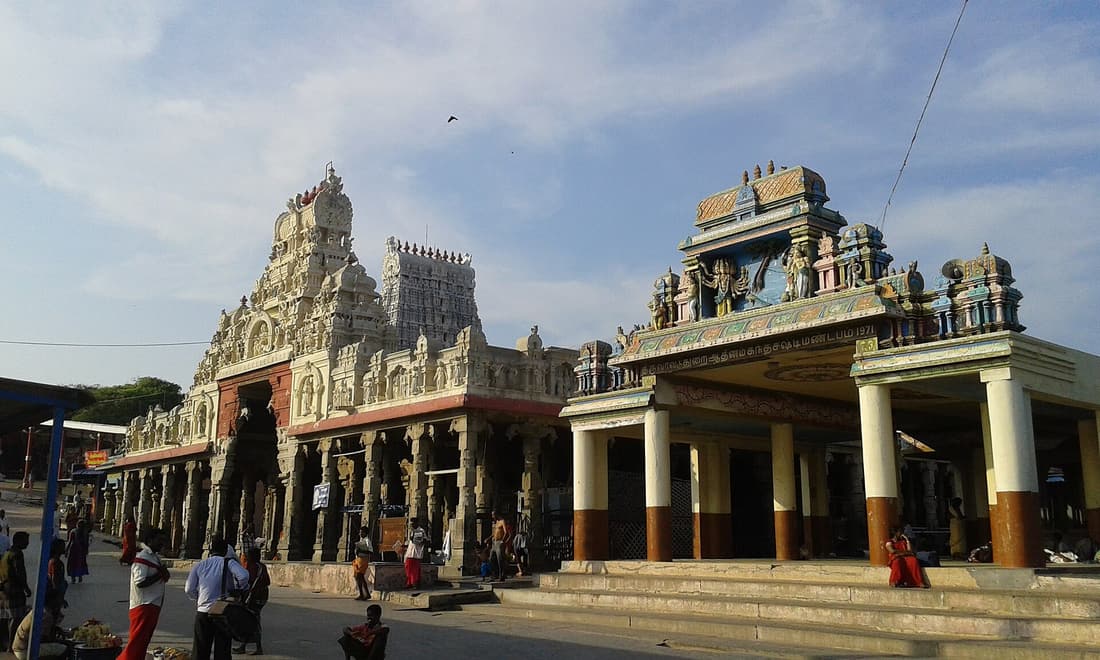
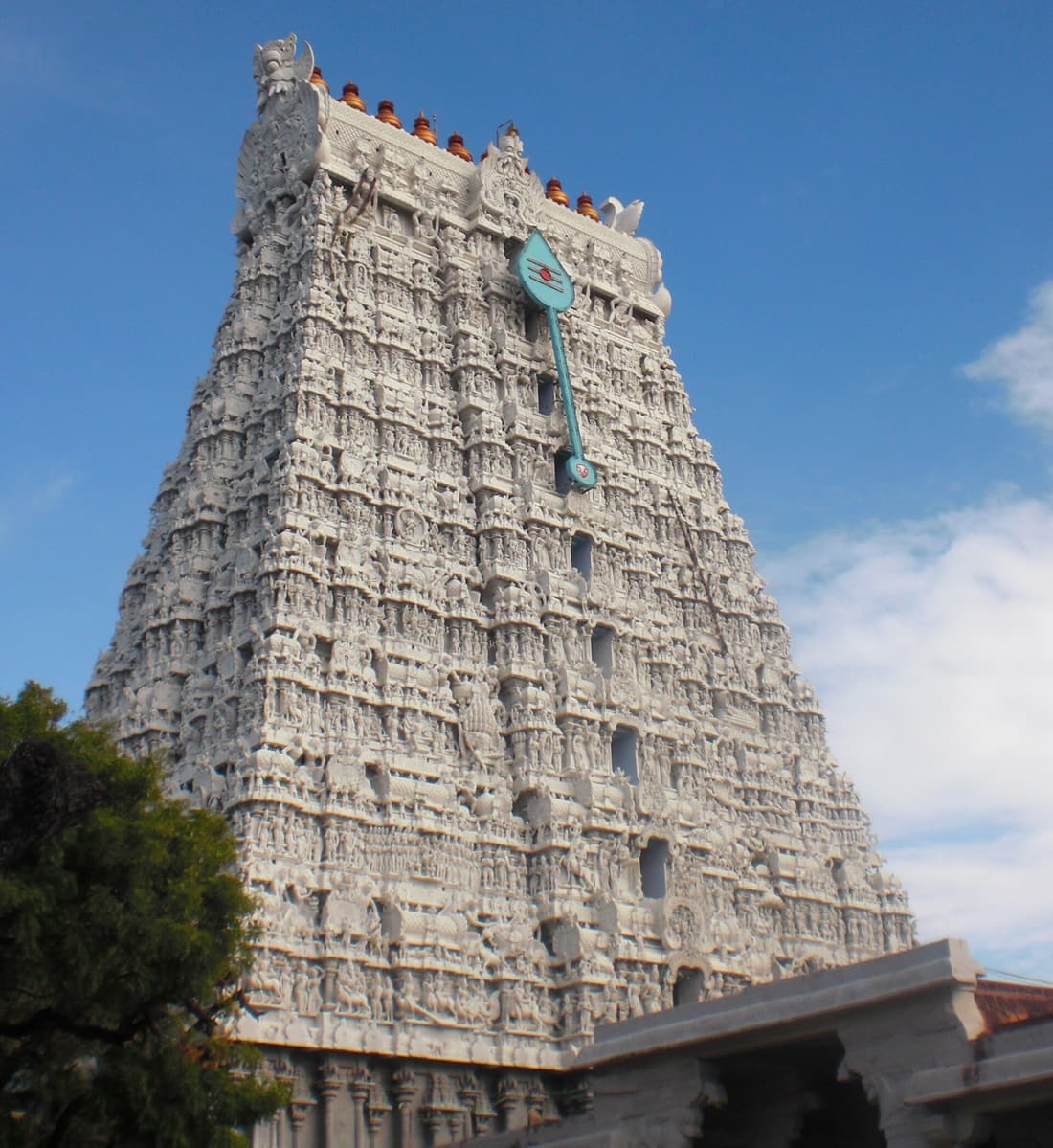
The complex measures 91 m by 65 m. The nine-tier gopuram is 157 ft (48 m) high, a figure given by both Wikipedia and the temple's official site. The main entrance faces south into the first of two prakarams, which are lined with yalis.[2][1]
Wikipedia places the temple on the shore of the Laccadive Sea in its lead and the Gulf of Mannar in another section, while the TN Temples Project says Bay of Bengal. The sea name is therefore not given here.being verified[2][3][1]
The Nali Kinaru, a sacred well fed by a freshwater spring, lies about 100 m south of the temple. Devotees bathe in its water after bathing in the sea.[2]
Darshan and queues
The official temple site says the temple is open from 4:00 AM to 9:00 PM continuously, with morning darshan from 4:00 AM to 12:00 noon and evening darshan from 12:00 noon to 9:00 PM. The free queue runs until 7:30 PM, the paid darshan queue closes at 6:30 PM, and a senior-citizen queue runs from 6:00 AM to 7:00 PM. The site says these are subject to administrative changes.[1]
The site lists changes on festival days: Margazhi opening at 3:00 AM and closing at 8:00 PM; Vaikasi Visakam and Thai Poosam opening at 1:00 AM; Masi and Avani festivals opening at 1:00 AM on the first and seventh days and 3:00 AM on other days; Kantha Sashti opening at 1:00 AM on the first and sixth days; and Panguni Uthiram opening at 4:00 AM.[1]
Nearby places
- Tirunelveli and Thoothukudi are the nearest cities for accommodation, and the TN Temples Project says budget and small options are available in Tiruchendur itself.[3]
How to reach
- The TN Temples Project lists Thoothukudi 43 km, Tirunelveli 66 km, Kanyakumari 97 km and Nagercoil 103 km. Its visitor section gives different figures of about 55 km to Tirunelveli and 40 km to Thoothukudi, so the distances are approximate.being verified[3]
- The official site links to nearest-places and bus-route pages but gives no directions in its text.[1]
Festivals
Photos
Timings
- Open 4:00 AM to 9:00 PM continuously; morning darshan 4:00 AM to 12:00 noon and evening darshan 12:00 noon to 9:00 PM — HR&CE, Government of Tamil Nadu [1]
- 5:00 to 12:00 and 1:00 to 9:00 (older listing) — TN Temples Project [3]
Frequently asked questions
Why is Tiruchendur different from the other Arupadai Veedu temples?
It is the only one of the six that is not on a hill; it stands on the seashore.[3][2]
What are the temple timings?
The temple's official site says it is open from 4:00 AM to 9:00 PM continuously, with different opening times on festival days.[1]
How long is Kanda Sashti at Tiruchendur?
Twelve days, longer than the usual six or seven days at other temples.[3]
How tall is the gopuram?
Nine floors and 157 ft (48 m), according to both Wikipedia and the temple's official site.[2][1]
What is the Nali Kinaru?
A sacred well fed by a freshwater spring about 100 m south of the temple, where devotees bathe after bathing in the sea.[2]
Sources
- Arulmigu Subramania Swamy Temple, Tiruchendur — HR&CE, Government of Tamil NaduOfficial (HR&CE) · accessed 2026-10-31
- Subramaniya Swamy Temple, Tiruchendur — WikipediaEncyclopedia (secondary) · accessed 2026-10-31
- Subrahmanyar, Tiruchendur, Thoothukudi — TN Temples ProjectTemple database (secondary) · accessed 2026-10-31
Page last checked:
Suggest a correction by email