- Overview
- Legend
- History
- What the official listings say
- Architecture
- Rituals and festivals
- In literature
- Festivals
- Photos
- Timings
- Questions
- Sources
Overview
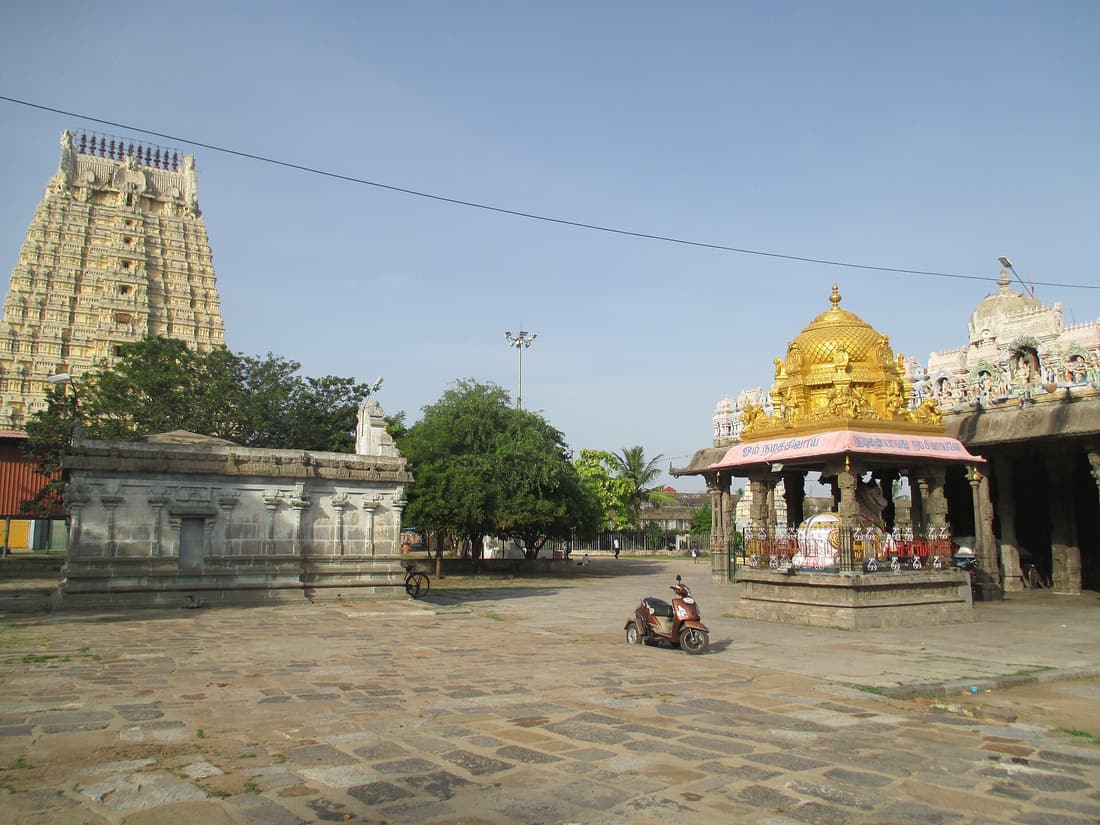
Ekambareswarar Temple (Kanchi Ekambaranathar Thirukkovil) is dedicated to Shiva and is one of the Pancha Bhoota Stalas, the five temples associated with the elements. It represents earth (Prithvi). Shiva is worshipped here as Ekambareswarar, Ekambaranathar or Rajalingeswaram, and his consort Parvati as Elavarkuzhali.[3]
Wikipedia calls it one of the largest temple complexes in India, with four gateway towers, and the most prominent attraction of the city. It is also a Paadal Petra Sthalam, praised in the Tevaram.[3]
Legend
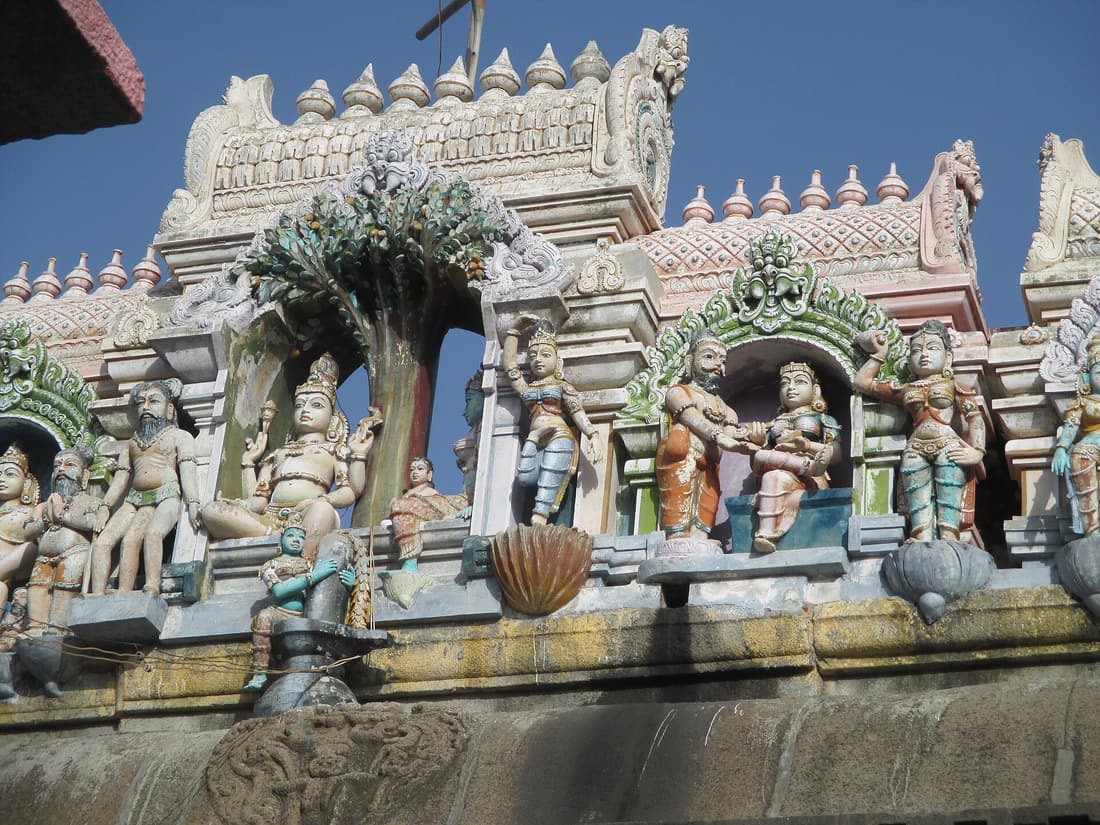
Parvati is said to have done penance under a mango tree near the Vegavati river. Shiva tested her by sending fire; she prayed to Vishnu, who brought the Moon whose rays cooled the tree. Shiva then sent the river Ganga, and Parvati reminded Ganga that they were sisters. She worshipped a lingam made of sand, and Shiva finally appeared as Ekambareswarar, "Lord of the Mango Tree".[3]
In another version the Vegavati overflowed and threatened to wash away the sand lingam, so Parvati as Kamakshi embraced it. Touched by the gesture, Shiva appeared and married her. In this context he is called Tazhuva Kuzhainthaar, "He who melted in Her embrace". Because the lingam is made of sand, Wikipedia says all ablutions are done only to the pedestal.[3]
The Nayanar saint Tirukuripputhonda, a washerman, is also linked to the temple. In the story, Shiva came as an old brahmin and asked him to wash clothes before dawn, then made the evening cloudy; the washerman, believing he had failed, struck his head on a stone, and Shiva appeared in his true form.[3]
History
Wikipedia says the temple has existed since at least 600 CE, and that Sangam-era works such as the Manimekalai and Perumpanarruppadai mention it. It was first built by the Pallavas, then pulled down and rebuilt by later Chola kings; the present masonry structure is attributed to the Chola period in the 9th century, with later expansion by the Vijayanagar rulers.being verified[3]
An inscription dated 1532 CE records village gifts made by Achutaraya. The eleven-storey southern gopuram is credited to Krishnadevaraya (1509-29). The Archaeological Survey of India report of 1905-06 records renovation work by the Nattukottai Chettiars, and Wikipedia says the temple was renovated with funds from Pachiyappa Mudaliar during British rule.[3]
Wikipedia states that a kumbhabhishekam was performed on 8 December 2025, in the presence of the Shankaracharyas of the Kanchi Kamakoti Peetham.[3]
What the official listings say
The temple's HR&CE page calls Ekambaranathar one of the ancient and oldest temples in Kanchipuram and says it is considered more than 1,300 years old. It says the temple is thought to be later than the Kailasanathar temple of Narasimha Pallava II, but that inscriptions of that king's time found in the complex have led historians to suspect an earlier brick temple on the site.[1]
The page says the complex has inscriptions from the Pallava to the Nayaka period, and that the large raja gopuram at the southern gate was built by the Vijayanagara king Krishnadevaraya, dated 1509 AD by its inscription. It adds that the Ayrangal Mandapam was earlier called the Nootruka Mandapam.[1]
The Ministry of Tourism's Incredible India page describes a 25-acre complex, a 9-storeyed gopuram over 192 feet tall built in 1509 CE by Krishnadevaraya, and elsewhere an 11-storey southern tower. It also says the temple may first have been a small wooden shrine built around 600 CE by the Pallava king Mahendravarman. The page is inconsistent on the storeys, which matches the disagreement already shown above, so the number of storeys is still being verified.being verified[2]
Architecture
There are four gopurams. The southern tower is the tallest, at 11 storeys. Wikipedia gives its height as 58.5 m in the lead, 57 m in the history section and 59 m in the architecture section, so the exact figure is not given here. The lower half of the gateway has shrines of Vinayaka and Murugan on either side.being verified[3]
Inside are the Vahana Mandapam, the Sarabesa (Navaratri) Mandapam and the thousand-pillared Aayiram Kaal Mandapam built under the Vijayanagar kings. The flagstaff hall has pillars carved with the legends and forms of Shiva. A temple tank and a small Ganesha shrine stand in the fourth courtyard.[3]
The sanctum holds a gold-plated lingam that depicts Parvati embracing it, with a plaque behind showing Shiva and Parvati. There are granite images of the 63 Nayanmars, a Sahasra Lingam with 1,008 lingams, and a separate Nataraja shrine. There is no separate Parvati shrine in the complex; a local belief holds that the Kamakshi Amman temple deity is his consort.[3]
The temple tree is said to be a 3,500-year-old mango tree whose four branches yield four kinds of mango. The Vishnu shrine of Nilathingal Thundam Perumal (Vamana), a Divya Desam, lies inside the complex.being verified[3]
Rituals and festivals
Wikipedia lists six daily rituals: Ushathkalam at 5:30 AM, Kalasanthi at 8:00 AM, Ucchikalam at 10:00 AM, Sayarakshai at 6:00 PM, Irandamkalam at 8:00 PM and Ardha Jamam at 10:00 PM. The lead says the rituals run from about 3:30-4:00 AM to 10 PM, so the two descriptions differ slightly.being verified[3]
The main festival is the ten-day Panguni Brahmotsavam (March-April), which ends with Kalyanotsavam, the reenactment of the marriage of Ekambareswarar. The lead calls it a thirteen-day festival, so the number of days is not settled. The fifth day has Ekambareswarar on a silver Nandi and the sixth day the procession of the 63 Nayanmars.being verified[3]
In literature
Sambandar, Appar and Sundarar each sang verses on Ekambareswarar in the Tevaram, and Manickavasagar also honoured the deity. The deity is also praised in the verses of Muthuswami Dikshitar and Pattinathar.[3]
Festivals
Photos
Timings
- Morning 6:00 AM to 12:30 PM, evening 4:00 PM to 8:30 PM; closed 1:00 PM to 4:00 PM (HR&CE listing) — HR&CE, Government of Tamil Nadu [1]
- Morning 6:00 AM to 12:30 PM, evening 4:00 PM to 8:30 PM (Incredible India, Ministry of Tourism) — Incredible India, Ministry of Tourism, Government of India [2]
- Six daily rituals: 5:30 AM, 8:00 AM, 10:00 AM, 6:00 PM, 8:00 PM and 10:00 PM (ritual times) — Wikipedia [3]
- The lead of the same article says rituals run from about 3:30-4:00 AM to 10 PM — Wikipedia [3]
Frequently asked questions
Which element does Ekambareswarar Temple represent?
Earth (Prithvi). It is one of the five Pancha Bhoota Sthalams.[3]
Why is the lingam made of sand?
In the legend Parvati made a lingam of sand under the mango tree. Because of this, ablutions are done only to the pedestal.[3]
How tall is the southern gopuram?
It has 11 storeys. Wikipedia gives several heights (57 m, 58.5 m and 59 m), so the exact figure is being verified.[3]
What is the main festival?
Panguni Brahmotsavam in March-April, ending with the Kalyanotsavam.[3]
Is there a Vishnu shrine in the temple?
Yes. The Nilathingal Thundam Perumal shrine, a Divya Desam, is inside the complex.[3]
What are the Ekambareswarar Temple timings?
The temple's official HR&CE listing gives darshan from 6:00 AM to 12:30 PM and 4:00 PM to 8:30 PM. Timings change on festival days.[1]
Sources
- Arulmigu Ekambaranathar Temple, Kancheepuram [TM001816] — HR&CE, Government of Tamil NaduOfficial (HR&CE) · accessed 2026-11-01
- Ekambareswarar Temple, Kanchipuram — Incredible India, Ministry of Tourism, Government of IndiaGovernment tourism portal · accessed 2026-11-01
- Ekambareswarar Temple (Kanchipuram) — WikipediaEncyclopedia (secondary) · accessed 2026-11-01
Page last checked:
Suggest a correction by email