- Overview
- History
- What the official listings say
- Architecture
- The circumambulatory passage
- Festivals
- Photos
- Timings
- Questions
- Sources
Overview
The Kailasanathar Temple is a Pallava-era Hindu temple dedicated to Shiva, and one of the oldest surviving monuments in Kanchipuram. Wikipedia says it was built around 700 CE by Narasimhavarman II (Rajasimha), with additions by Mahendravarman III. It has a mukha-mandapa, a maha-mandapa and a main sanctum under a four-storey vimana.[3]
The temple is noted for its carved sculpture, mostly of Shiva but also with themes from Vaishnavism, Shaktism and Vedic deities, for early Hindu mural art on the inner cell walls of the courtyard, and for early inscriptions. Wikipedia says the murals resemble the style found at Ajanta and in the 8th-century Vaikunta Perumal temple at Kanchipuram.[3]
History
The Pallavas ruled from Kanchipuram, which is regarded as one of the seven sacred cities of Hinduism. Wikipedia names the Tiru Parameswara Vinnagaram (Vaikunta Perumal) and the Kailasanathar Temple as two of the great specimens of Pallava temple architecture from 640-730 CE.[3]
It is described as the first structural temple built in South India, as earlier temples were of wood or cut into rock, as at Mahabalipuram. It became a model for later temples. By local belief it served as a refuge for the rulers in war, and a tunnel used as an escape route is still visible. Another belief holds that Raja Raja Chola I visited it and drew inspiration for the Brihadeeswara Temple.being verified[3]
The temple is the site of what Wikipedia calls the earliest stone inscription recording the 28 Shaiva Agamas, in which King Rajasimhavarman states his faith in Shaivism.[3]
What the official listings say
Tamil Nadu Tourism describes it as a Pallava-era temple built around 700 CE by Narasimhavarman II, "one of the finest examples of classical Dravidian architecture". It says the temple is square in plan, made of sandstone on a granite foundation (which is why it is locally called the Sand Temple), with a four-storey vimana, nine shrines around the sanctum (seven outside and two inside) and 58 small shrines in all.[2]
The same page says the sanctum holds a 16-sided black granite lingam and that the pedestal has carved images and a sculpted Nandi. It recommends visiting between October and February, and gives the distances of Chennai airport as about 62.4 km and Kancheepuram station as about 2.9 km.[2]
Incredible India repeats the date of about 700 CE, says Maha Shivaratri is the most significant festival, and says the temple remains an active place of worship with daily rituals. It calls the temple a mix of rock-cut and stone-built elements, while Wikipedia says it is a structural stone temple, so this detail is not used elsewhere.being verified[1]
Architecture
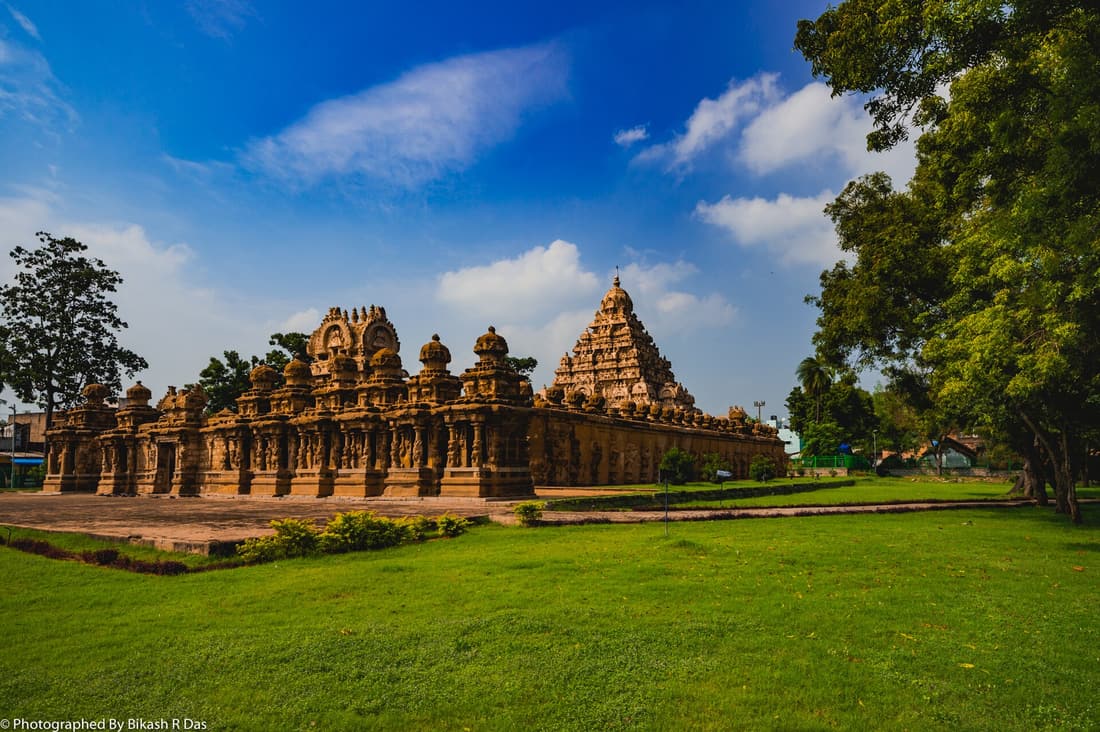
The temple is built of stone. The foundations are granite and the superstructure, including the carvings, is sandstone. The vimana is square in plan and rises in a pyramidal form to a small dome-shaped roof. The mandapa was first detached and later joined to the shrine by an ardhamandapa, which Wikipedia says marred the beauty of the temple to some extent.[3]
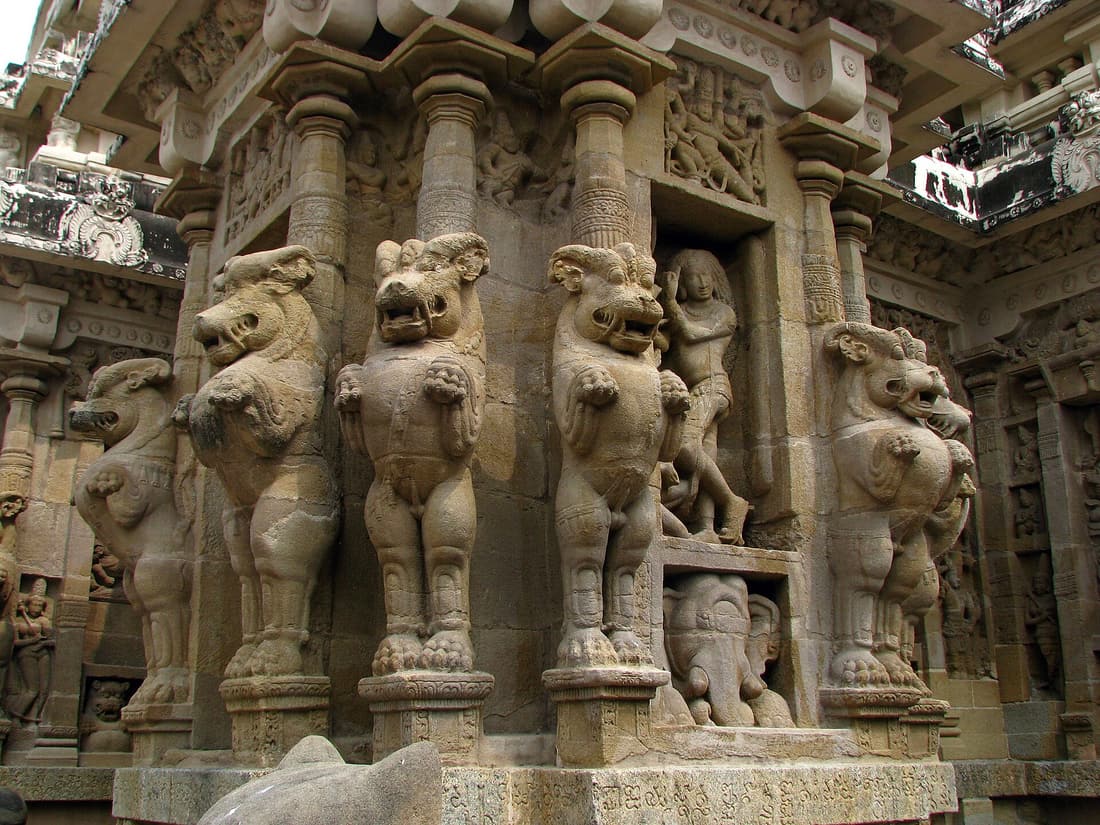
The pillars have seated lion bases, a Pallava feature, and the sculptures of rearing lions are a notable feature. The main shrine has a 16-sided black granite lingam and a carved pedestal with a Nandi guard. The compound wall holds 58 small shrines with Shiva and Parvati reliefs, and the entrance wall holds eight more small shrines.[3]
The outer walls of the main shrine show Shiva as Umamaheshvara with Lingodbhava on the south, as Sandhya and Urdhva Tandavamurti on the west, and as Tripurantaka on the north. The inner prakara walls show Durga, Kartikeya, Narasimha, Trivikrama, Gangadhara, Bhikshatana and Ardhanarishvara seated on a bull, which Wikipedia calls the most noteworthy image. Two sculptures show Shiva holding an alapini veena.[3]
Wikipedia also notes a suggestion that the temple may have been built using a geopolymer that looks like sandstone.being verified[3]
The circumambulatory passage
A narrow passage along the compound wall is entered by climbing seven steps and crawling through; devotees take it as a symbol of passage through life. The entry is called the Gate of Death and the exit the Gate of Birth. By belief, completing it breaks the cycle of rebirth. Maha Shivaratri is the biggest festival at the temple.[3]
Festivals
Photos
Timings
- Morning 9:00 AM to 12:30 PM; evening 4:00 PM to 6:30 PM, which the page labels "closing time", so it is unclear whether this is the evening opening period or the closing time (Incredible India, Ministry of Tourism) — Incredible India, Ministry of Tourism, Government of India [1]
Frequently asked questions
Who built the Kailasanathar Temple?
Narasimhavarman II (Rajasimha) built it around 700 CE; his son Mahendravarman III completed the facade and gopuram.[3]
Why is it historically important?
It is described as the first structural temple in South India and an early model for later temples, with early murals and inscriptions.[3]
How many small shrines does it have?
58 small shrines are built into the compound wall, plus eight on the entrance wall.[3]
What is the Gate of Death and Gate of Birth?
The entry and exit of a narrow circumambulatory passage that devotees crawl through, symbolising passage through life, death and rebirth.[3]
What are the Kailasanathar Temple timings?
The Ministry of Tourism lists morning hours of 9:00 AM to 12:30 PM and an evening period of 4:00 PM to 6:30 PM that it labels "closing time", so please check locally.[1]
Sources
- Kailasanathar Temple, Kanchipuram — Incredible India, Ministry of Tourism, Government of IndiaGovernment tourism portal · accessed 2026-11-01
- Kailasanathar Temple — Tamil Nadu Tourism, Government of Tamil NaduGovernment tourism portal · accessed 2026-11-01
- Kailasanathar Temple, Kanchipuram — WikipediaEncyclopedia (secondary) · accessed 2026-11-01
Page last checked:
Suggest a correction by email