- Overview
- Legends
- The goddess in five forms
- History
- What the official listings say
- Architecture and shrines
- Worship and festivals
- Festivals
- Photos
- Timings
- Questions
- Sources
Overview
The Kamakshi Amman Temple, also called Kamakoti Nayaki Kovil, is dedicated to the goddess Kamakshi, a primary aspect of Adi Shakti. It stands in Kanchipuram, and Wikipedia describes it as a major centre of Shaktism in Tamil Nadu and one of the 18 main Shakta Pithas.[3]
The complex also holds a shrine for Vishnu as Varaha Perumal. This is the Tirukkalvanur Divya Desam, one of the 108 sacred sites of the Sri Vaishnava tradition. The original shrine was a little way from the temple; because it fell into ruin, the deity was placed inside the Kamakshi temple, in the belief that Vishnu is the brother of Kamakshi.[3]
Legends
The Shakta Pitha
In the story of Daksha's sacrifice and Sati's self-immolation, parts of Sati's body are said to have fallen at the sites that became Shakta Pithas. The navel is believed to have fallen at Kanchipuram, giving the name Nabhi Peetham or Odhyana Peetham.[3]
Bhandasura and the parrots
According to the Puranas, the devas were tormented by the demon Bhandasura and prayed to Adi Parashakti in the form of parrots perched on champaka trees at the temple. The goddess is said to have appeared through the Bila gate and killed him. The Bila gate leading to the Bilakasha tree can be seen today in front of the Tapa Kamakshi shrine.[3]
Parvati under the mango tree
Wikipedia relays a legend that Parvati, separated from Shiva, moved to Kanchipuram on the advice of the sage Katyayana, worshipped Shiva as Ekambareswara under the mango tree near the Vegavati river, and married him. The Kamakshi shrine has no separate Shiva shrine.[3]
The goddess in five forms
The temple worships Kamakshi in five forms. Sri Kamakshi Para Bhattarika is the main deity, seated in the centre of the sanctum, in front of a Sri Yantra that the temple history says was placed by Adi Shankaracharya. Tapa Kamakshi stands to the right near the Bila gate, shown as a yogini in a balancing pose. Anjana Kamakshi, also called Arupa Lakshmi, has a shrine to the left, where kumkum is offered to her before devotees receive it.[3]
Swarna Kamakshi (Bangaru Kamakshi) is in the second enclosure. The current idol is made of panchaloha, and Wikipedia says the original golden idol was taken to Thanjavur by a man named Kamakshi Dasar during the invasions. Utsava Kamakshi, the processional idol, is also in the second enclosure, flanked by Saraswati and Lakshmi.[3]
Koskoff, cited by Wikipedia, refers to a legend that the golden statue was carried across South India after the fall of the Vijayanagar Empire in 1565, enshrined in the Tiruvarur temple from 1739 to 1781, and that the Kamakshi Amman temple was built for it in 1783.being verified[3]
History
The temple may have been founded by the Pallava kings in the 5th-8th century CE, when Kanchipuram was their capital, and it was modified in the 14th and 17th centuries. Wikipedia also notes a view, attributed to Babu, that the Cholas built it in the 14th century, so the founding period is not settled.being verified[3]
The Divya Desam shrine is praised by the Vaishnava Alvars in the Naalayira Divya Prabandham, compiled in the 9th century.[3]
The temple is the centre of the Kanchi Kamakoti Peetham. The Shankaracharya of the Peetham is the hereditary trustee of the Kamakshi Ambal Devasthanam, and the Peetham looks after its rituals and festivals.[3]
What the official listings say
The temple is listed on the HR&CE portal as the Sri Kamakshi Ambal Devasthanam, Sri Kanchi Kamakoti Peedam, Sri Madam Samasthanam, Big Kancheepuram. Its page names the deity as Devi Kamakshi, described as Tripura Dhaarini, and draws its introduction from the Markandeya Purana (Vidya Khanda), in which King Suratha asks the sage Markandeya about the Peethas.[1]
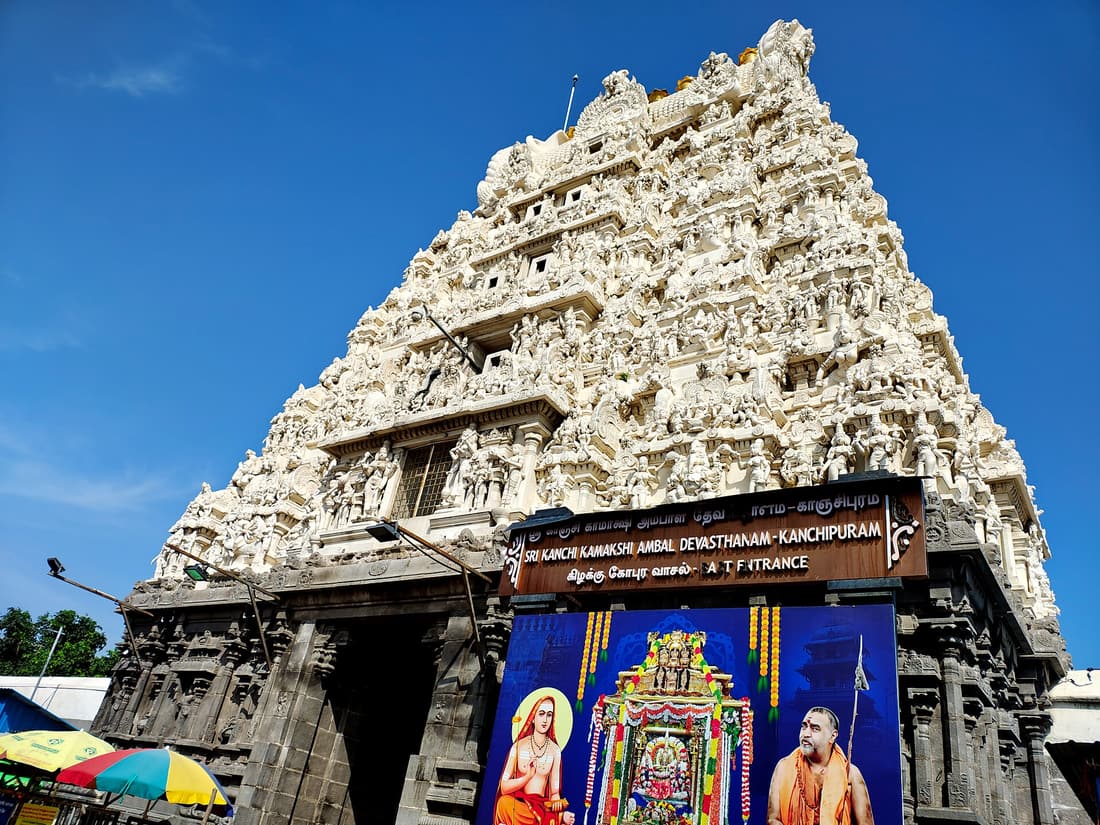
The Ministry of Tourism's Incredible India page describes Kamatchi Amman as a form of Parvati worshipped as the embodiment of Shakti, a Dravidian temple with a towering gopuram, several mandapams and walls with murals and sculptures. It names Navaratri, a nine-day celebration in September or October, as the main festival.[2]
Architecture and shrines
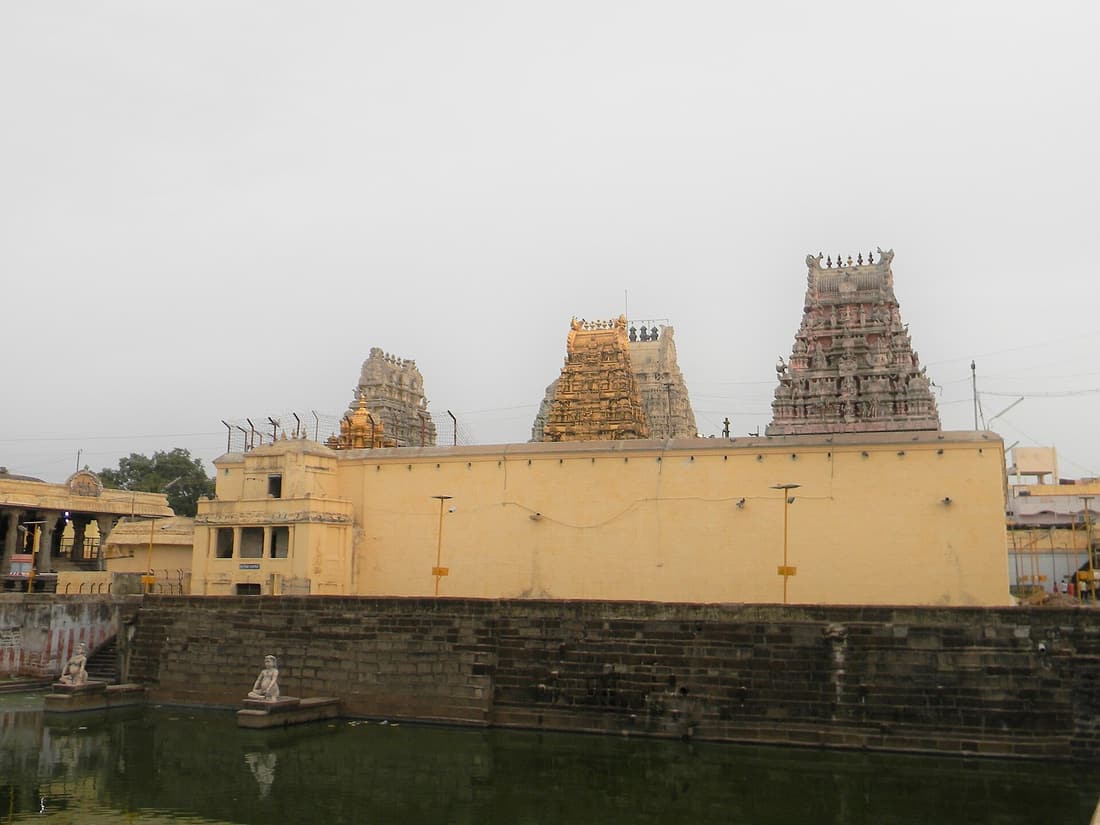
The temple covers about 5 acres. The sanctum holds Kamakshi seated and is flanked by the trinity of Shiva, Vishnu and Brahma. Smaller shrines of Bangaru Kamakshi, Adi Shankara and Saraswati stand around it.[3]
The Gayatri Mandapa in front of the sanctum is described in the Kamakshi Rahasya as built by the celestials, with four walls for the four Vedas and 24 pillars for the 24 syllables of the Gayatri mantra. In front of the main shrine is a shrine to Durvasa, who is believed to have consecrated a Sri Yantra here. A third enclosure has shrines for Hayagriva and the sage Agastya, at the place where Agastya is said to have learned the Lalita Sahasranama.[3]
Worship and festivals
Four worship services are offered each day. The rituals begin with Gau Pooja and Gaja Pooja, and Wikipedia says the temple elephants offer worship by trumpeting at 5 AM.[3]
The annual festival is in the Tamil month of Masi (mid-February to mid-March), with Masi Pooram as the main day, plus a chariot festival and a float festival. Other festivals include Navaratri, Aadi and Aippasi Pooram, Sankara Jayanthi and the Vasanta Utsavam in Vaikasi. Fridays are sacred, especially those in Adi and Thai.[3]
Festivals
Photos
Timings
- Morning 5:30 AM to 12:30 PM; break 12:30 PM to 3:45 PM; evening opening listed as 3:45 to 9:00, which the page labels "AM" and is probably a typing error for PM (HR&CE listing, text cut off after "Morning 05.30") — HR&CE, Government of Tamil Nadu [1]
- Morning 5:30 AM to 12:15 PM, evening 4:00 PM to 8:15 PM; open until 9:30 PM on Fridays (Incredible India, Ministry of Tourism) — Incredible India, Ministry of Tourism, Government of India [2]
- Four worship services are offered daily; the temple elephants offer worship at about 5 AM (no darshan hours given) (Wikipedia, for comparison) — Wikipedia [3]
Frequently asked questions
Why is the Kamakshi Amman Temple important?
It is described as one of the 18 main Shakta Pithas, where the navel of Sati is believed to have fallen, and it is a major centre of Shaktism in Tamil Nadu.[3]
Is there a Vishnu shrine inside the temple?
Yes. The Tirukkalvanur Divya Desam shrine, with Vishnu as Varaha Perumal, is inside the complex.[3]
Who looks after the temple?
The Kanchi Kamakoti Peetham; its Shankaracharya is the hereditary trustee of the Kamakshi Ambal Devasthanam.[3]
When is the main festival?
The annual festival is in Masi (mid-February to mid-March), with Masi Pooram as the main day.[3]
Sources
- Sri Kamakshi Ambal Devasthanam, Sri Kanchi Kamakoti Peedam, Big Kancheepuram [TM001865] — HR&CE, Government of Tamil NaduOfficial (HR&CE) · accessed 2026-11-01
- Kamatchi Amman Temple, Kanchipuram — Incredible India, Ministry of Tourism, Government of IndiaGovernment tourism portal · accessed 2026-11-01
- Kamakshi Amman Temple — WikipediaEncyclopedia (secondary) · accessed 2026-11-01
Page last checked:
Suggest a correction by email