- Overview
- A place between his parents
- What the official listings say
- Legend
- The Kanda Puranam
- Worship and festivals
- Festivals
- Photos
- Timings
- Questions
- Sources
Overview
The Kumara Kottam temple in Kanchipuram is dedicated to Murugan, the war god and son of Shiva and Parvati, and is also called the Subramaniya Swami temple. Wikipedia describes it as one of the 21 major temples of Kanchipuram. The saint Arunagirinathar sang hymns in praise of its Murugan.[3]
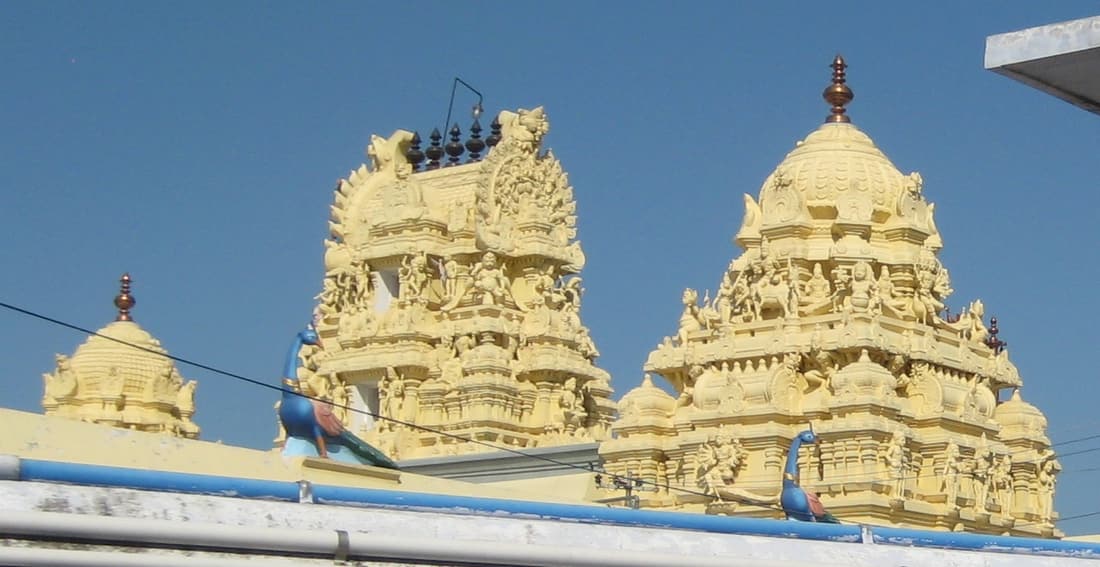
The ancient temple was rebuilt in its present form in 1915 CE. The shikara over the sanctum is granite, shaped as a circular dome called a chakra vimanam, which Wikipedia describes as a Chola-period structure. The corbels and pilasters carry epigraphs.[3]
A place between his parents
The temple stands on Raja Street, between the Ekambareswarar temple of Shiva and the Kamakshi Amman temple of Parvati. Wikipedia explains that this setting echoes the Somaskanda form of Shiva, which shows the child Murugan seated between his parents. Each of the three temples keeps its own identity, and all the temples of Kanchipuram are described as dedicated to one extended divine family.[3]
What the official listings say
The temple's HR&CE page says it is important for the Kandhapuranam sung by Kachiyappa Sivachariyar, and that during the writing Lord Murugan himself pronounced the first line, "Thigada". The page gives no founding date.[1]
The Ministry of Tourism's Incredible India page names Skanda Sashti (October-November) and Vaikasi Visakam (April-May) as the main festivals. It also tells a story that a manuscript was found one night to have been improved, near the image of Murugan, which devotees took as the deity's approval of the text.[2]
Legend
The Kanda Puranam says that Murugan imprisoned the creator god Brahma here because Brahma did not know the meaning of Om, and took over the role of creator himself. Shiva ordered him to release Brahma. Realising his error, Murugan did penance before a lingam, which became known as Devasenapathisar. In another version the humbled Brahma was released after worshipping Murugan.[3]
Murugan's central image is unusual: it is shown as Brahma-Shasta, holding a water pot and rudraksha beads. The lingam he worshipped has its own shrine in the complex.[3]
The Kanda Puranam
Kacchiyappa Sivacharyar, a Tamil scholar and priest here, composed the Kanda Puranam, the Tamil telling of the Skanda Purana. It has six cantos and 10,346 stanzas. The Kandapurana Arangetra Mandapam, where he is said to have composed it, still exists in the complex. It is believed that Murugan himself wrote the first line of the first stanza and corrected 100 stanzas written by the priest during the day. The temple priests are said to be descendants of Kacchiyappar.[3]
Worship and festivals
Worship is scheduled six times daily. Kandha Shashti, on the sixth day of the waxing half of Karthigai, is a popular festival, and in Karthigai many lamps are lit. Each lunar month, on the Krittika star, the temple draws many devotees. Like other Kanchipuram temples, it holds a Brahmotsavam with morning and evening processions.[3]
Wikipedia lists Kandha Shashti as November, while the Ministry of Tourism page gives Skanda Sashti as October-November. The Ministry of Tourism page also names Vaikasi Visakam (April-May) as a main festival.[3][2]
Festivals
Photos
Timings
- Morning 5:00 AM to 12:00 PM, evening 4:00 PM to 8:00 PM; festival times change (official HR&CE listing) — HR&CE, Government of Tamil Nadu [1]
- Morning 7:00 AM to 11:30 AM, evening 3:30 PM to 8:00 PM (Incredible India, Ministry of Tourism) — Incredible India, Ministry of Tourism, Government of India [2]
- Worship is scheduled six times daily (no visiting hours given) (Wikipedia, for comparison) — Wikipedia [3]
Frequently asked questions
What is special about Kumarakottam?
It is where Kacchiyappa Sivacharyar composed the Tamil Kanda Puranam, and its Murugan is shown as Brahma-Shasta.[3]
Where is it?
On Raja Street, between the Ekambareswarar and Kamakshi Amman temples.[3]
When was the present temple built?
It was rebuilt in its present form in 1915 CE.[3]
Why is Murugan between the two temples?
It echoes the Somaskanda form, in which the child Murugan sits between Shiva and Parvati.[3]
Sources
- Arulmigu Subramaniya Swami Temple (Kumarakkottam), Kancheepuram [TM001701] — HR&CE, Government of Tamil NaduOfficial (HR&CE) · accessed 2026-11-01
- Sri Subramaniya Swami Temple (Kumara Kottam), Kanchipuram — Incredible India, Ministry of Tourism, Government of IndiaGovernment tourism portal · accessed 2026-11-01
- Kumarakottam Temple — WikipediaEncyclopedia (secondary) · accessed 2026-11-01
Page last checked:
Suggest a correction by email