- Overview
- Legends
- History
- What the official listings say
- Architecture
- Rituals and festivals
- Festivals
- Photos
- Timings
- Questions
- Sources
Overview
Tirupavalavannam, or Pavalavanam temple, is a Dravidian-style Vishnu temple in Kanchipuram, glorified in the Naalayira Divya Prabandham and counted among the 108 Divya Desams. Vishnu is worshipped as Pavalavannar Perumal ("the coral-coloured") and his consort as Pavalavalli.[2]
Wikipedia says the temple is believed to have been built by the Cholas. The lead describes a seven-tiered rajagopuram and the architecture section a five-tiered one, so the number of tiers is being verified.being verified[2]
Legends
The regional legend says Vishnu took different colours in different eras: white in the Satya Yuga, the colour of pavalam (coral or emerald) in the Treta Yuga, green in the Dvapara Yuga and a bluish tint in the Kali Yuga. He is believed to have appeared to the Ashvini twins as Pavalavannar and kept the name.[2]
A second legend says Saraswati sent an army of demons to attack Brahma during his penance, and Vishnu defended him and was smeared with blood-red colour, hence the name Pravalesa or Pavalvannan. A third tells of the sage Bhrigu, who tested the trinity by kicking Vishnu; Vishnu massaged his foot, and he sent the sage to Kanchipuram to complete his penance, where he appeared as Pavalavannar. The sage's image is in the sanctum.[2]
History
The temple has inscriptions from the Chola period (10th-12th centuries) and the Vijayanagara period (15th-16th centuries). Peyalvar, Thirumalisai Alvar and Thirumangai Alvar sang about it. In 2014 a litigation in the Chennai High Court split control between the hereditary trustee and the HR&CE Department, according to Wikipedia.[2]
What the official listings say
The HR&CE portal lists the Pavalavannar and Pachaivannar temples together as one institution, which fits the twin-temple pairing described by Wikipedia. Its "About Temple" section says "Data not found", so it gives no history.[1]
Architecture
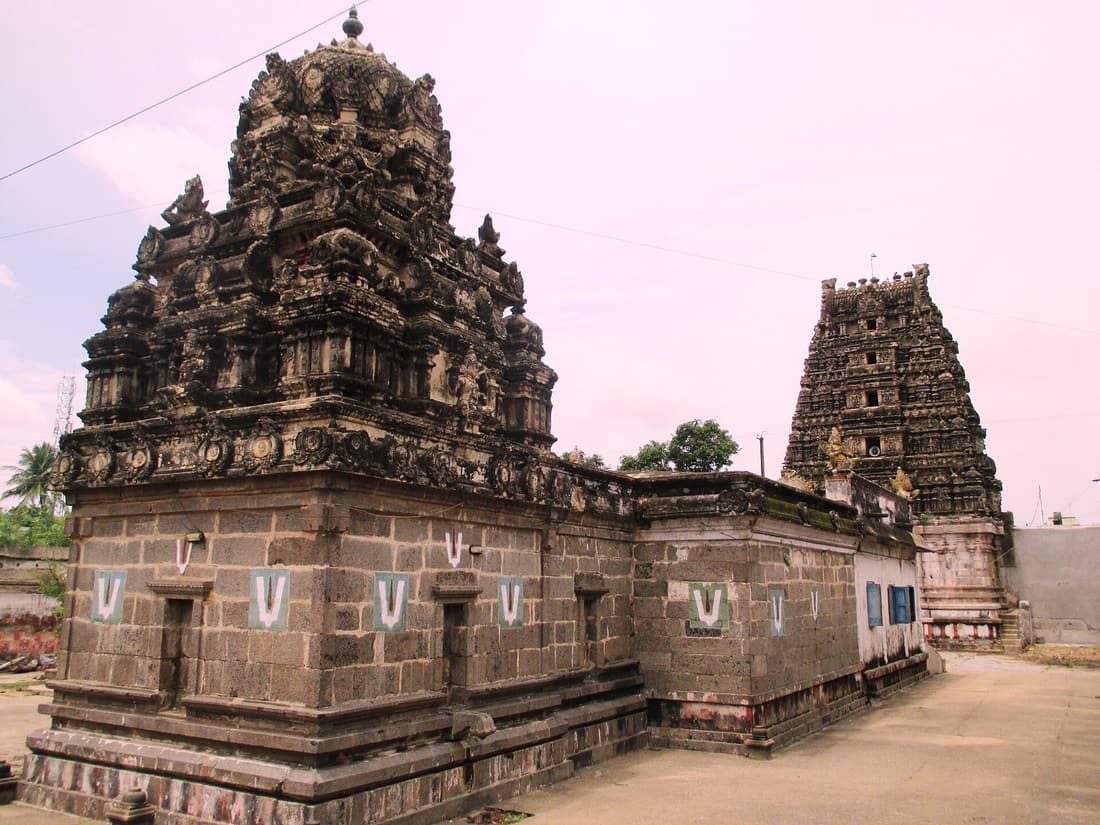
The west-facing sanctum is reached through the flagstaff and pillared halls, the Mahamandapam and Ardhamandapam. The central image of Pavalavannar is standing; the sanctum also houses the festival image and an image of Santhanagopala Krishnan. Separate shrines of the Alvars stand north of the flagstaff, and pillars carry images of Nammalvar, Ramanuja and Manavala Mamunigal. There are also shrines of Rama with Sita and Hanuman, and Garuda.[2]
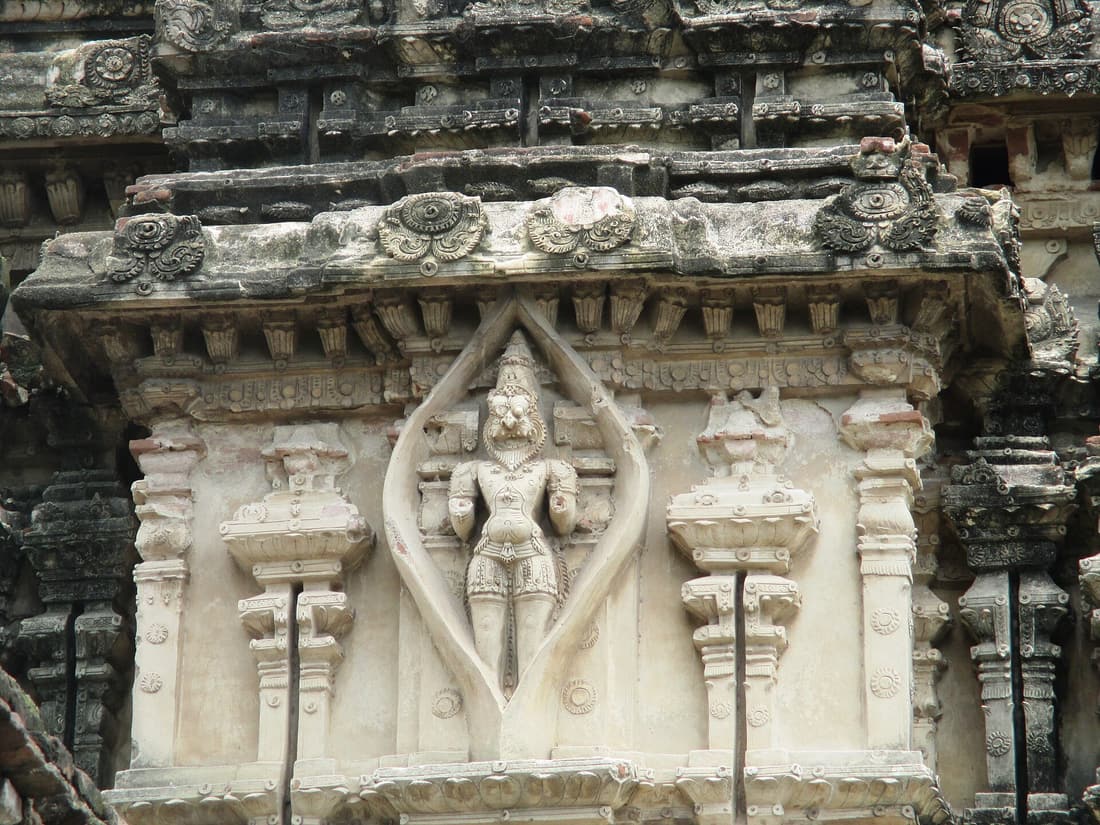
The five-tier gopuram is studded with stucco images of legends, notably Narasimha slaying Hiranya. The Pavalavalli shrine faces the central shrine on the east side, and a shrine of Manavala Mamunigal stands on the left of the gopuram.[2]
Rituals and festivals
The temple follows the Tenkalai tradition and the Vaikhanasa agama. Six daily rituals are listed by Wikipedia at 7 AM, 8 AM, 12 noon, 6 PM, 7 PM and 10 PM. The main festival is the Brahmotsavam in Vaikasi (May-June), with Pavitrotsavam in Panguni (March-April) and Vaikuntha Ekadashi in Margali (December-January) also celebrated.[2]
Festivals
Photos
Timings
- Morning 7:30 AM to 11:30 AM, evening 5:30 PM to 7:00 PM in the table; the page's text line says evening 5:30 to 7:30 (official HR&CE listing) — HR&CE, Government of Tamil Nadu [1]
- Six daily rituals: 7 AM, 8 AM, 12 noon, 6 PM, 7 PM and 10 PM (ritual times) — Wikipedia [2]
Frequently asked questions
What does Pavalavannam mean?
It means the colour of coral (or emerald), referring to the colour Vishnu took in the Treta Yuga.[2]
Is it a Divya Desam?
Yes. Peyalvar, Thirumalisai Alvar and Thirumangai Alvar sang about it.[2]
Which direction does the temple face?
West.[2]
When is the main festival?
The Brahmotsavam in Vaikasi (May-June).[2]
What are the Pavalavannam Perumal Temple timings?
The official HR&CE listing gives 7:30 AM to 11:30 AM and about 5:30 PM to 7:00 or 7:30 PM.[1]
Sources
- Arulmigu Pavalavannar and Pachaivannar Temple, Kancheepuram [TM001727] — HR&CE, Government of Tamil NaduOfficial (HR&CE) · accessed 2026-11-01
- Pavalavannam Temple — WikipediaEncyclopedia (secondary) · accessed 2026-11-01
Page last checked:
Suggest a correction by email