- Overview
- Legend
- History
- What the official listings say
- Architecture
- Rituals and festivals
- Festivals
- Photos
- Timings
- Questions
- Sources
Overview
Tiru Parameswara Vinnagaram, today usually called the Vaikunta Perumal Temple, is a Vishnu temple built in stone by the Pallava emperor Nandivarman II Pallavamalla. Its original names were Paramechuravinnagaram in Tamil and Vishnugriha in Sanskrit, meaning "Vishnu-house", a royal palace for Parameshvara.[2]
Wikipedia notes that the temple has helped date portions of the Bhagavata Purana, and that the historian D. Dennis Hudson wrote a detailed study decoding it as an architectural summa of that Purana.[2]
Legend
According to local tradition, the sage Bharadvaja was doing penance on the unbuilt site when a celestial nymph attracted him, and their son was left on earth. Vishnu, disguised as a hunter, gave the child to a childless Pallava king, and the child later became king and built the temple. Wikipedia points out that this departs from the mainstream view that Nandivarman II built it.[2]
History
Hultzsch is cited as saying it was built in 690 CE, while other scholars place it in the late 8th century. Rhie dates it on style to about 770-775 CE and sees it as a Vaishnava answer to the Shaiva Kailasanatha Temple built some fifty years earlier by Rajasimha. The date is therefore not settled.being verified[2]
Thirumangai Alvar, a contemporary of Nandivarman II, composed a poem on the temple in the Periya Tirumoli, which helps anchor the date. Inscriptions show royal patronage into the 9th century, including a golden vessel given by Dantivarman I in 813.[2]
What the official listings say
The HR&CE page lists it as one of the Divya Desams in Big Kanchipuram, half a mile from Kanchipuram railway station, and calls it, like the Kailasanathar temple, one of the oldest temples in Kanchipuram. It says the temple was constructed in the 6th century by the Pallava king Nandivarman, which differs from Wikipedia's dates (690 CE to the late 8th century), so the date is being verified.being verified[1]
The page says the temple was originally called Parameswara Vinnakaram after the king, has three layers rising in ascending stages, and has a mandapa built after the Vijayanagara period. It describes an incomplete entrance tower and pillars carved with male and female deities.[1]
Architecture
The temple is an early example of Dravidian architecture, laid out as a three-dimensional chakrabja-mandala (lotus and wheel). The vimana has a stepped pyramidal roof and is surrounded by a drainage moat that symbolically represents the Kshira Sagara around Vaikuntha. Three levels host Vishnu seated, reclining (accessible on ekadashi days) and standing (not accessible).[2]
The cloister walls carry a sequence of relief panels telling the history of the Pallava dynasty: first its supposed divine lineage from Brahma to Ashwatthama, then actual kings, including panels on the battles of Mahendravarman I and Narasimhavarman I with Pulakesin II, and the search for a successor after Paramesvaravarman II.[2]
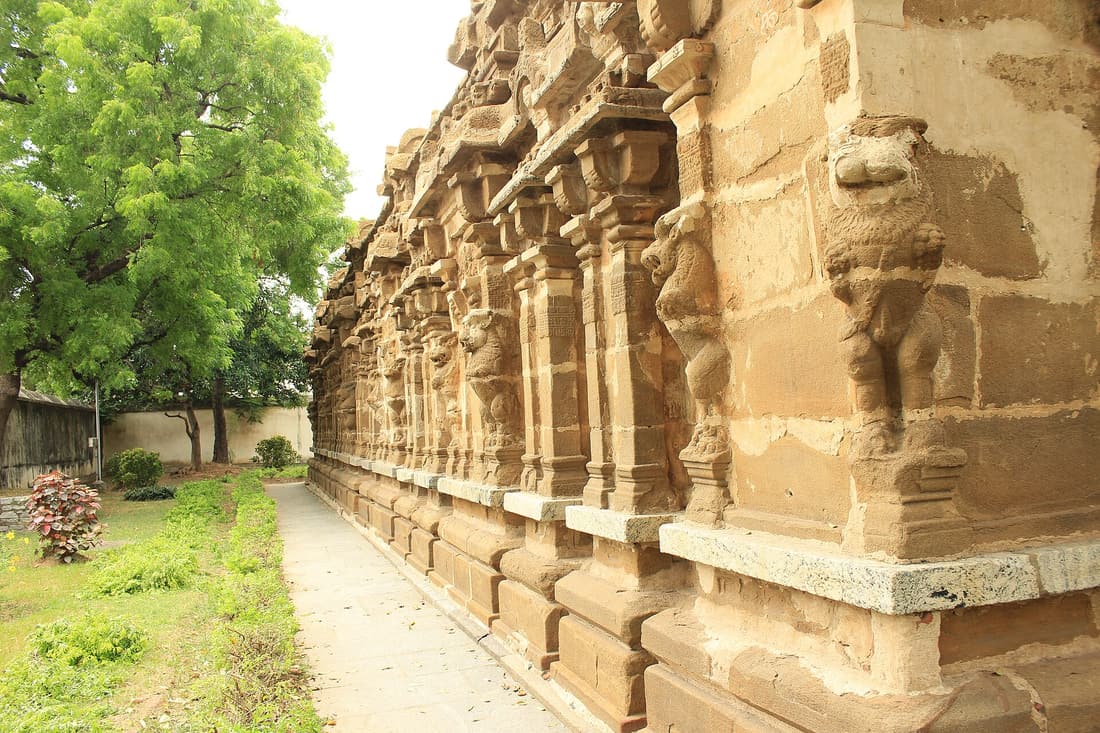
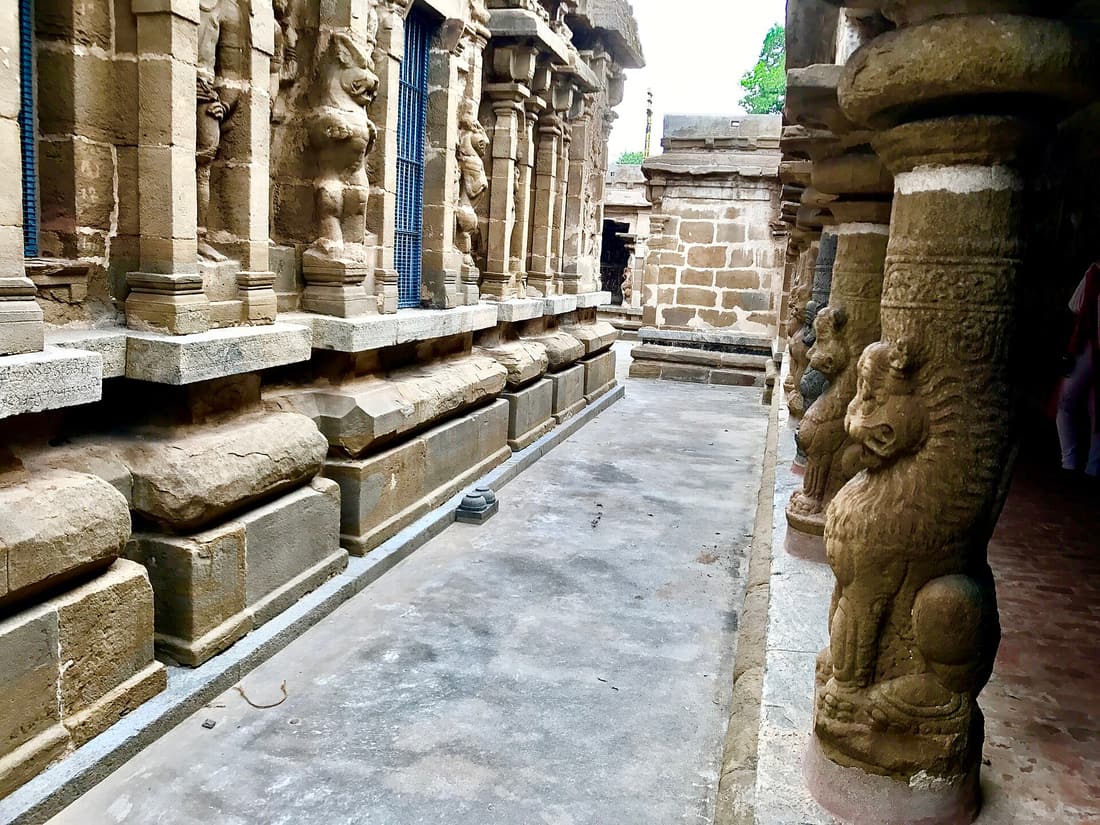
The temple uses granite with some sandstone. The external cloisters, with lion pillars, anticipate later thousand-pillared halls; in modern times the lions have been replaced by Garudas. Wikipedia names it as the forerunner of temples such as Uthiramerur, Koodal Azhagar at Madurai and Rajagopalaswamy at Mannargudi.[2]
Rituals and festivals
The temple follows the Vaikhanasa Agama, with six daily rituals listed by Wikipedia at 7:30 AM, 8:00 AM, 12:00 noon, 5:00 PM, 6:00 PM and 7:30 PM. The two major festivals are the Vaikasi Brahmotsavam (May-June) and Vaikunta Ekadashi (December-January).[2]
Festivals
Photos
Timings
- Morning 7:00 AM to 11:30 AM, evening 4:00 PM to 7:30 PM (official HR&CE listing) — HR&CE, Government of Tamil Nadu [1]
- Six daily rituals: 7:30 AM, 8:00 AM, 12:00 noon, 5:00 PM, 6:00 PM and 7:30 PM (ritual times) — Wikipedia [2]
Frequently asked questions
Who built the Vaikunta Perumal Temple?
Nandivarman II Pallavamalla, in the 8th century; scholars differ on the exact date.[2]
What is special about its sanctum?
It has three levels, with Vishnu seated, reclining and standing; the reclining level is open to devotees on ekadashi days.[2]
What do the cloister panels show?
They show the history of the Pallava dynasty, from its divine lineage to the actual kings and the choice of Nandivarman II as successor.[2]
Is it a Divya Desam?
Yes. It is praised by Thirumangai Alvar and is one of the 14 Divya Desams in Kanchipuram.[2]
What are the Vaikunta Perumal Temple timings?
The official HR&CE listing gives 7:00 AM to 11:30 AM and 4:00 PM to 7:30 PM.[1]
Sources
- Arulmigu Vaigunthaperumal Temple, Periya Kancheepuram [TM001663] — HR&CE, Government of Tamil NaduOfficial (HR&CE) · accessed 2026-11-01
- Tiru Parameswara Vinnagaram — WikipediaEncyclopedia (secondary) · accessed 2026-11-01
Page last checked:
Suggest a correction by email