- Overview
- Legend
- Atthi Varadhar
- History
- What the official listings say
- Architecture
- Festivals and Vedic recitation
- Festivals
- Photos
- Timings
- Questions
- Sources
Overview
Varadharaja Perumal Temple is dedicated to Vishnu and is one of the 108 Divya Desams. It lies in Vishnu Kanchi, the part of the city that holds many Vishnu temples. Wikipedia says the great Vaishnava philosopher Ramanuja is believed to have lived here.[3]
Along with the Ekambareswarar and Kamakshi Amman temples it is called Mumurtivasam, the "abode of the trio". Among the Divya Desams, Srirangam is called "Koil", Tirupati "Malai" and Kanchipuram's Varadharaja temple "Perumal Koil". Wikipedia adds that Vaishnavites believe visiting these places without a break leads to paramapadam.[3]
Legend
In one legend, Saraswati cursed Indra to become an elephant; Vishnu appeared as Hastagiri, the hill in the form of an elephant, and freed him. Indra is believed to have installed the silver and golden lizards in the temple. In another, Brahma performed a yagna here that the Vegavati (today's Palar) river threatened to wash away, until Vishnu lay flat to stop the flow.[3]
A further legend says disciples of the sage Gautama were cursed to become lizards, lived in the temple and were freed by Vishnu. A panel in the roof shows the two lizards.[3]
Thirukkachi Nambigal (Kanchi Purna), an ardent devotee, brought flowers daily and fanned the deity; it is believed Varadharaja conversed with him. Ramanuja is regarded to have received answers to six questions from Varadharaja through him.[3]
Atthi Varadhar
Besides the stone image, the temple has a wooden image of Varadharaja made of atthi (fig) wood, about 3 m tall. It is stored in a secret chamber under the water of the Anantha Saras tank and brought out once every 40 years for 48 days: the first 24 days in a reclining pose and the next 24 days standing. It is worshipped in the Vasantha Mandapam.[3]
Wikipedia says the wooden image was originally the presiding deity and was hidden in the 16th century to protect it from invaders. It was replaced by the present stone image when the wooden one could not be traced, and was accidentally rediscovered in 1709 when the tank was emptied. The article lists earlier exposure dates of 1979, 1939, 1892 and 1854.[3]
History
The temple has around 350 inscriptions. It was renovated by the Cholas in 1053 and expanded in the reigns of Kulottunga Chola I and Vikrama Chola; another wall and a gopura were added in the 14th century. A 1511 CE epigraph records the Dvaita saint Vyasatirtha presenting a village and a serpent vehicle.[3]
When a Mughal invasion was expected in 1688, the main image was sent to Udayarpalayam, near Tiruchirappalli. It was returned only after the intervention of Attan Jeer; Wikipedia gives 1710 as the year the situation allowed the return, and the event is commemorated as a festival.[3]
Robert Clive is said to have visited the Garuda Seva festival and presented a necklace, now called the Clive Maharkandi, which is worn on a special occasion each year.[3]
What the official listings say
The temple's official HR&CE website lists it as the Arulmigu Devarajaswamy Temple, Little Kancheepuram, with the deities Varadharaja Perumal and Bargavi. It says Kancheepuram is one of the seven sacred cities that can bestow moksha (Ayodhya, Madurai, Maya, Kasi, Kanchi, Avantika and Dwaraka), was the capital of Thondai Mandalam, and was ruled by Pallava kings for a number of years.[1]
The page records the "Sri Atthi Varadhar Festival 2019" in its What's new section, which fits the 40-year cycle of the Atthi Varadhar darshan listed in earlier years (1979, 1939, 1892 and 1854).[1]
Incredible India lists Varadharaja Perumal with consort Perundevi Thayar, and mentions a Kannadi Arai (Mirror Chamber) and a 100-pillar hall. That page also confuses the temple with Tirunelveli (it mentions a Tirunelveli railway station and the Thamirabarani river), so only its timings and the points that match the HR&CE page and Wikipedia are used here.being verified[2]
Architecture
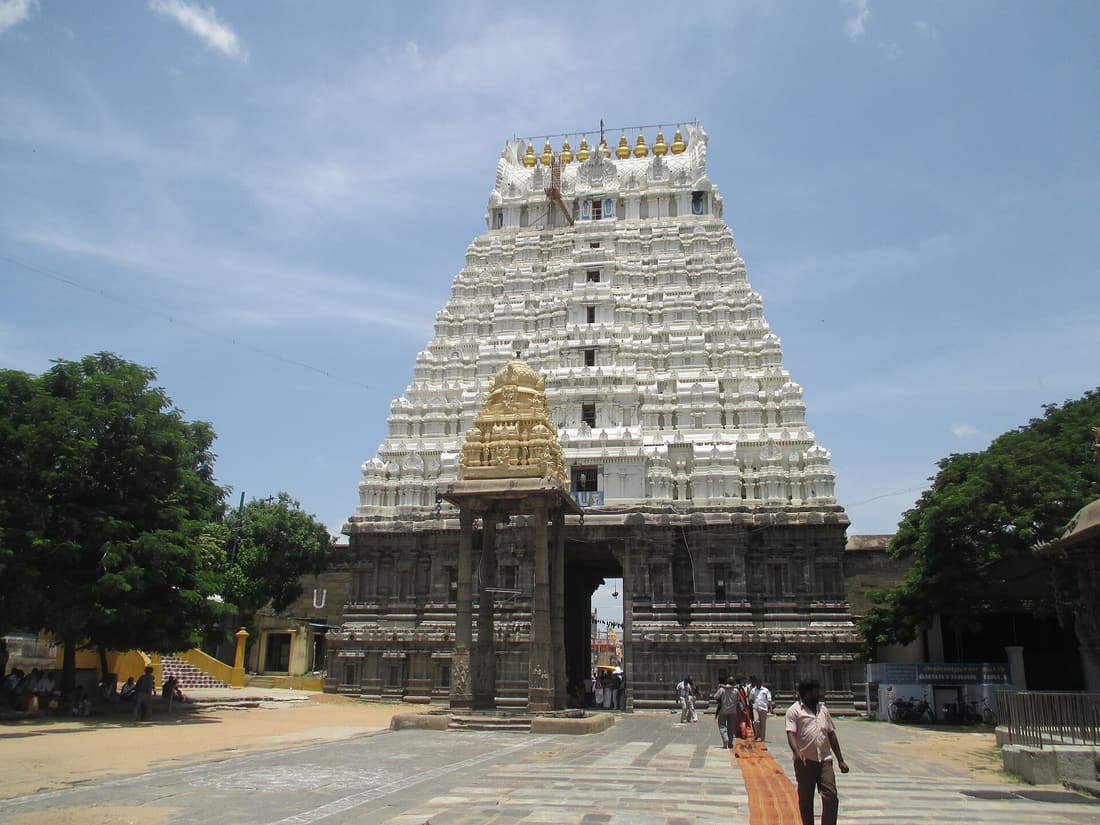
The temple stands in Chinna Kanchipuram, on the eastern side of the city. The west-facing sanctum is entered through a 7-tier gopuram about 40 m tall; the eastern gopuram (55 m) is taller than the western one (49 m), which is unusual for large temples. The sanctum vimana is called Punyakoti Vimanam, and the Perundevi Thayar shrine has the Kalyana Koti Vimanam.being verified[3]
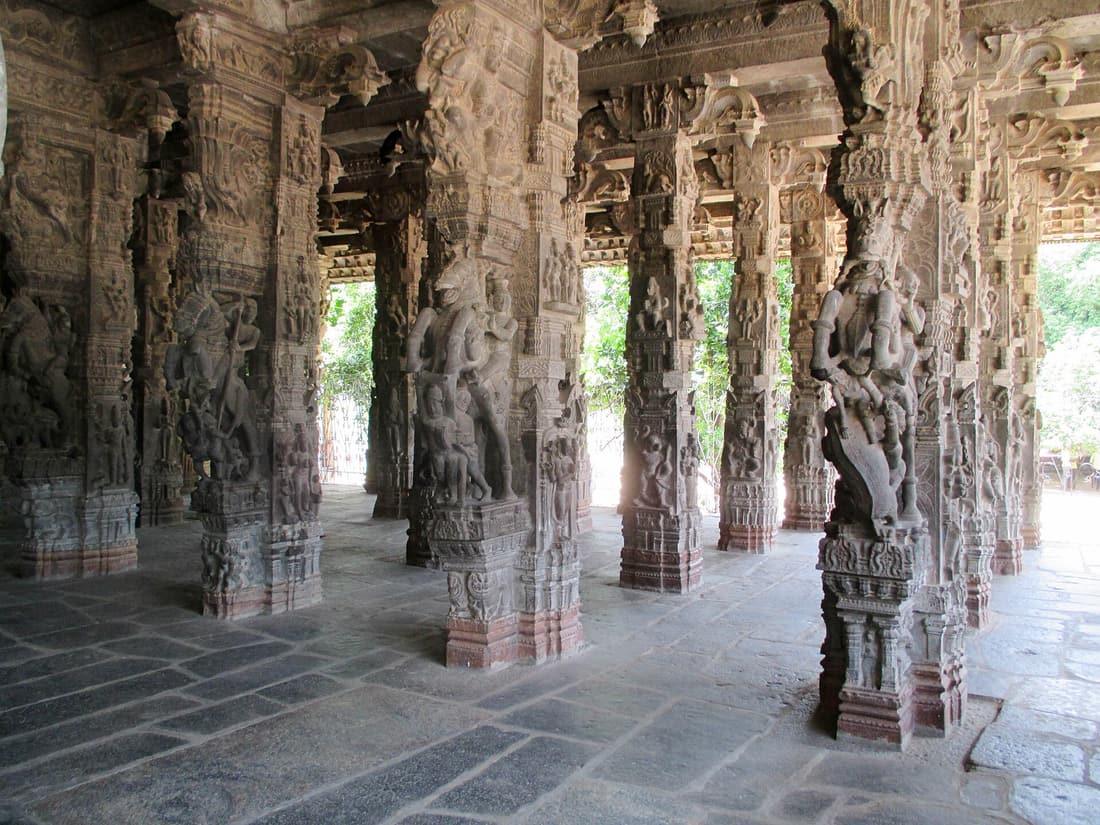
The hundred-pillared hall is a work of the Vijayanagara period, with sculptures from the Ramayana and Mahabharata and a famous stone chain carved from a single stone. The most notable sculptures include Rati, Manmatha, Lakshmi Narayana, Lakshmi Narasimha, Lakshmi Varaha and Lakshmi Hayagreeva. The ceiling of the Hastagiri shrine has late Vijayanagara murals, and gilded lizards are carved over the sanctum.[3]
There is a Narasimha shrine on the hillock and a large six-armed Chakratalvar shrine east of the tank, believed to date from 1191 CE under Kulottunga III. It is customary to visit the Perundevi Thayar shrine first. The temple car is believed to have been donated by Krishnadevaraya in 1517 CE.[3]
Festivals and Vedic recitation
Wikipedia describes it as the only major Sri Vaishnava temple in Tamil Nadu with priority to Vedic recitation. Vedanta Desika mentions an annual ten-day festival in May, which is the Brahmotsavam. Tyagaraja and Muthuswami Dikshitar composed songs on the festival.[3]
Festivals
Photos
Timings
- Morning 7:30 AM to 12:30 PM, evening 3:30 PM to 8:00 PM; break 8:00 PM to 8:30 PM; the page also lists 11:00 AM to 12:00 noon and 3:30 PM to 5:00 PM without saying what they are; darshan timings change on kattana seva, festival and utsavam days (official HR&CE website) — HR&CE, Government of Tamil Nadu [1]
- Open 6:00 AM to 12:00 PM and 4:00 PM to 9:00 PM (Incredible India, whose page for this temple contains location errors) — Incredible India, Ministry of Tourism, Government of India [2]
Frequently asked questions
What is special about Atthi Varadhar?
A 3 m fig-wood image of Varadharaja is kept under the water of the temple tank and brought out for worship for 48 days once every 40 years.[3]
Is this a Divya Desam?
Yes. It is one of the 108 Divya Desams of Vishnu, and is called Perumal Koil among them.[3]
How large is the temple?
About 9.5 hectares (23.5 acres), the largest temple in Kanchi.[3]
Who is the consort of Varadharaja?
Perundevi Thayar, whose shrine in the third precinct is customarily visited first.[3]
What are the Varadharaja Perumal Temple timings?
The official HR&CE website gives morning darshan from 7:30 AM to 12:30 PM and evening darshan from 3:30 PM to 8:00 PM, with changes on festival days.[1]
Sources
- Arulmigu Devarajaswamy Temple, Little Kancheepuram [TM001864] — HR&CE, Government of Tamil NaduOfficial (HR&CE) · accessed 2026-11-01
- Sri Varadharaja Perumal Temple, Kanchipuram — Incredible India, Ministry of Tourism, Government of IndiaGovernment tourism portal · accessed 2026-11-01
- Varadharaja Perumal Temple, Kanchipuram — WikipediaEncyclopedia (secondary) · accessed 2026-11-01
Page last checked:
Suggest a correction by email