- Overview
- Legend: Brahma's pot and the birth of Kumbakonam
- History
- Architecture and layout
- Shrines and special images
- Worship and special practices
- Tevaram hymns and sacred ranking
- The Mahamaham
- Kumbakonam Sapta Sthanam
- Nearby temples
- How to reach
- Festivals
- Photos
- Timings
- Questions
- Sources
Overview
Adi Kumbeswarar Temple stands in the middle of Kumbakonam in Thanjavur district. It is a Shiva temple, and the name Adi (first, original) reflects the belief that this is the oldest Kumbeswarar temple and the oldest temple in the town. The presiding deity is Adi Kumbeswarar, worshipped as a lingam, and his consort is Mangalambigai, also known as Mantra Peeteswari.[2][1]
The temple is a Paadal Petra Sthalam, meaning that the Tevaram hymns of the Shaiva saints praise it. It is also one of the temples linked with the Mahamaham festival, which draws pilgrims to the town once every twelve years.[3][2]
Unlike many temples, the Shiva and Parvati shrines stand within the same campus.[2]
Legend: Brahma's pot and the birth of Kumbakonam
The pot that survived the flood
According to the sthala purana, Brahma placed the seeds of all living things, together with the Vedas and Puranas, in a pot (kumbha) called the Amrita Kalasam, and set it on Mount Meru. When the great deluge (pralaya) came, the pot was carried away and floated on the floodwaters for years. It finally came to rest at the spot that is now Kumbakonam.[2][1]
Shiva, appearing as a hunter, broke the pot open with an arrow. The nectar and its contents spilled, sanctified the land, and gave rise to the holy tanks (theerthams) and temples of the town. One account says the lingam here was shaped by Shiva himself from the nectar mixed with sand.[2][3][1]
The name Kumbakonam is explained as kumbham (pot) and konam (corner, or angle), the corner where the pot settled. This temple is believed to mark the place where the kumbham came to rest, and so it is called Adi Kumbeswarar.[3][2]
Two tanks from one nectar
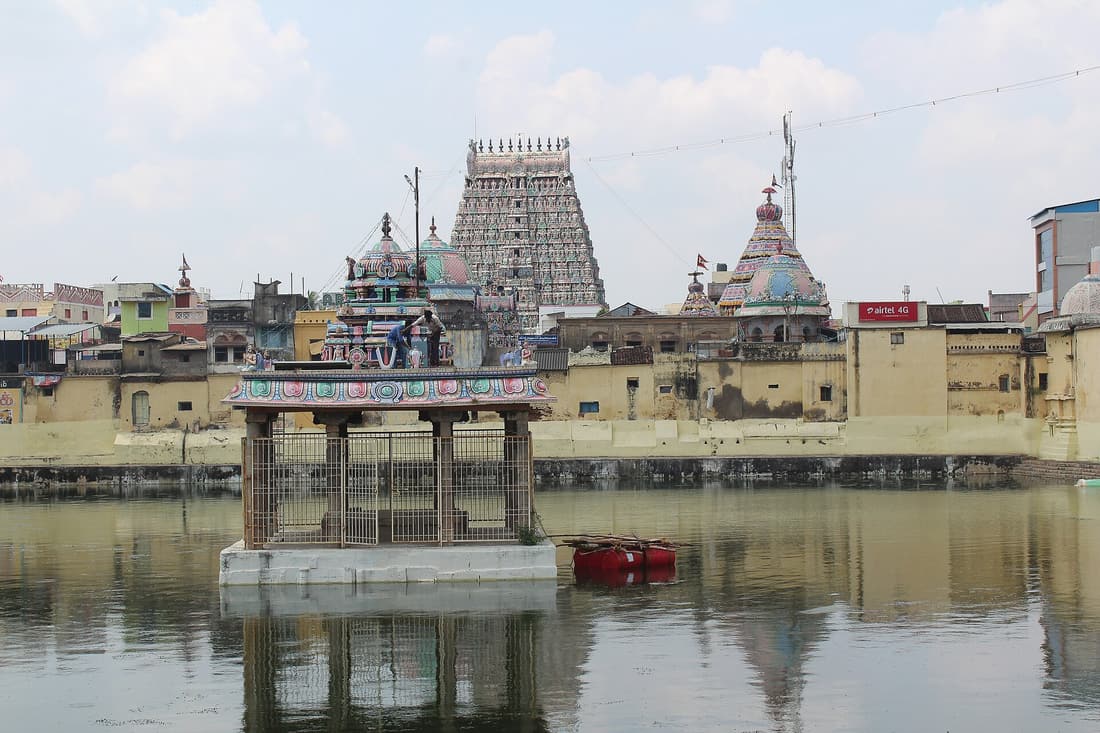
Nectar fell in two places, which are identified with the Mahamaham tank and the Potramarai tank. The Potramarai tank lies between this temple and the Sarangapani temple.[2][1]
Adi Vinayakar and Mantra Peeteswari
The Vinayakar here is called Aadi Vinayakar because, in the story of the divine mango fruit, he arrived here ahead of Shiva and Parvati. In another tradition, Shiva gave 36 crore mantras to Parvati, who already held 36 crore, giving her 72 crore in all; she is therefore called Mantra Peeteswari. She is shown wearing a yellow sari, with turmeric on her body and kumkumam on her face.[2]
Murka Nayanar, one of the 63 Nayanmars, is said to have attained liberation (mukti) at this temple.[2]
History
The temple belongs to the Chola period, and Wikipedia dates it to the 9th century. One temple listing says 7th century, so the date is flagged as being verified. The sources agree that it was enlarged in later centuries: by the Vijayanagara rulers and the Thanjavur Nayaks in the 16th century, and a travel guide adds the Marathas.being verified[1][2][4]
The Vijayanagara period gave the temple a sixteen-pillared hall. A Tulapurushadanam (weighing oneself against gold and giving it away) performed by Govinda Dikshitar funded the sixteen mandapas around the Mahamaham tank. Krishnadeva Raya is believed to have attended the Mahamaham between 1509 and 1529 CE and to have made donations recorded in an inscription.[1]
Today the Hindu Religious and Charitable Endowments Department of the Government of Tamil Nadu administers the temple.[1]
Architecture and layout
The temple is an example of Dravidian architecture, built along an east-west axis with three concentric enclosures and a triple set of gopurams. The east gateway is the main entrance, and a covered approach about 330 ft (100 m) long and 15 ft (4.6 m) wide leads to the temple.[1][3][4]
Sources differ on the main tower. Wikipedia describes four gopurams, the tallest on the east with 11 storeys and a height of 128 ft (39 m), and also mentions a 9-storey tower of 125 ft. Another listing says the rajagopuram is about 128 ft high. The page therefore gives about 128 ft as the commonly reported height and flags the discrepancy.being verified[1][3][4]
The complex is reported to cover 30,181 sq ft by Wikipedia, while another passage in the same article says it spreads over 4 acres, so no single figure is given as certain.being verified[1]
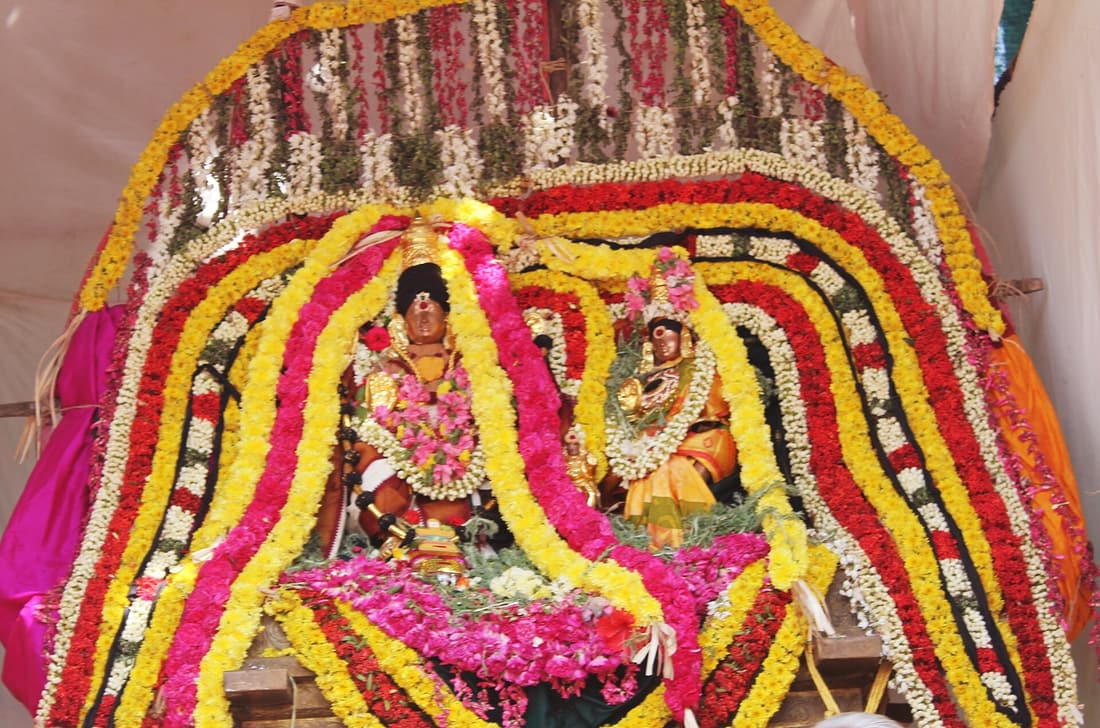
Five silver-plated chariots carry the deities during festivals, and the temple has stone nadaswarams, a six-handed Subramanya, and a Kiratamurti image.[1]
Shrines and special images
- Navaratri Mandapam: the 27 stars (nakshatras) and 12 rasis are depicted here, carved from a single block according to Wikipedia.[2][1]
- Chitra Nritta Mandapam (hall of dance), noted for its sculptures and carvings.[3]
- Kiratha form of Shiva: Shiva is worshipped here in the form of a hunter.[3]
- Muruga shrine behind the main sanctum: Karthikeya sits on a peacock with Valli and Deivanai. Arunagirinathar praised this Muruga in his Tiruppugazh. The page for the temple says this six-faced, six-handed form is found only here among Muruga shrines in Tamil Nadu.[3]
- Jvarahareswarar, believed to cure fevers and ailments, with his three sacred footprints, and Bhairavar.[3]
- Lakshmi Narayana Perumal near the flagstaff; Dandapani Swami in the outer prakaram; goddesses Annapurani, Mahalakshmi and Saraswathi.[3]
- The 63 Nayanmars, the Navagrahas, Veerabhadra, Sapta Kanya, Ashta Lingams, Somaskandar, Valanchuzhi Vinayaka, Mahalingeswarar and Pitchadana Murthi (Bhikshatana) also have images or shrines.[3][1]
Worship and special practices
One listing describes the deity as a sacred clay pot (kudam) and says abhishekam is performed only after the idol is adorned with golden armour. On full-moon (Pournami) days the deity is anointed with punugu, an aromatic substance.[3]
The temple holds special pujas on Pradosham (the 13th day of each lunar fortnight), on Pournami and Amavasya, and on Mondays (Somavaram), when abhishekam is offered and devotees walk around the sanctum.[4]
Devotees traditionally bathe in the Mahamaham tank before praying at the temple.[4]
A daily pooja schedule with times was not found in the sources reviewed, so none is given here.[1]
Tevaram hymns and sacred ranking
The temple is sung in the Tevaram by Appar (Tirunavukkarasar) and Sambandar. The shivatemples.com listing records one pathikam from each, and describes the temple as number 26 among the Paadal Petra temples south of the Kaveri (Tiru-Kudamookku).[3][2]
Wikipedia says Appar wrote nine verses calling the place Kudamuku and the deity Kumbesar, and gives a pathikam of Sambandar in the Third Tirumurai. It lists the temple as a Paadal Petra Sthalam and also as one of the Shakta pithas, with Mangalambigai as the main deity.[1]
The Mahamaham
The Mahamaham is held once every twelve years in the Tamil month of Masi (February-March). One account gives the astronomical conditions: Jupiter (Guru) in Leo (Simha), the Sun in Kumbha (Aquarius), and a full moon under the Magha star.[3][1]
Pilgrims bathe in the Mahamaham tank in the town centre; one listing says the tank covers about 20 acres. The tradition holds that the sacred rivers Ganga, Yamuna, Saraswati, Narmada, Sindhu, Kaveri, Godavari, Sarayu and Porunai come as maidens to bathe and purify the tank on that day.[3][1]
A procession of twelve Shiva deities from different temples accompanies the festival, and tens of thousands of pilgrims attend, according to one travel guide.[4]
Adi Kumbeswarar is one of the twelve temples associated with the Mahamaham. Five Vishnu temples of Kumbakonam, including Sarangapani, are linked with it as well.[2][5]
Kumbakonam Sapta Sthanam
This temple is part of the Kumbakonam Sapta Sthanam, a group of seven Shiva temples: Adi Kumbeswarar (Kumbakonam), Amritakadeswarar (Sakkottai), Avudainathar or Atmanathar (Darasuram), Kapardeeswarar (Tiruvalanchuzhi), Kotteeswarar (Kottaiyur), Kailasanathar (Melacavery) and Sundareswarar (Swamimalai), as listed by the TN Temples Project.[2]
Nearby temples
- Sarangapani Temple, the Divya Desam Vishnu temple in Kumbakonam; the Potramarai tank lies between the two temples.[2][1]
- Mahamaham tank, in the town centre, where pilgrims bathe during the festival.[4]
- Airavatesvara Temple at Darasuram, a UNESCO World Heritage Site, is listed as a nearby attraction.[4]
- The shivatemples.com page gives distances from this temple to other Paadal Petra temples, including Tiru-Kottaiyur (5.5 km), Vadathali (5 km), Tiru-Sakthi-Muththam (5.8 km), Patteswaram (6 km), Tiru-Valan-Chuzhi (7 km) and Tiru-Nageswaram (8.5 km).[3]
How to reach
- Address: Thanjavur Main Road, Kumbakonam, Tamil Nadu 612001.[4][3]
- By train: Kumbakonam railway station is about 2.5 km away. By bus: Kumbakonam bus stand is about 2 km away.[4]
- By air: Tiruchirappalli International Airport is about 100 km away, roughly 2 to 3 hours by road.[4]
- Kumbakonam is about 40 km from Thanjavur and 99 km from Tiruchirappalli. Accommodation for all budgets is available in the town.[2]
Festivals
Photos
Timings
- 6:00 AM to 12:30 PM and 4:00 PM to 9:30 PM — TN Temples Project [2]
- 6:00 AM to 12:30 PM and 4:00 PM to 9:30 PM — Culture and Heritage [4]
- Morning 6:00 to 1:00 PM and evening 4:00 to 8:00 PM — shivatemples.com [3]
- 6:00 AM to 12:30 PM and 4:30 PM to 9:00 PM — Bajaj Finserv [6]
- Evening session from about 4:00 PM to 8:30 PM — Lilac Hotels [7]
Frequently asked questions
Why is it called Adi Kumbeswarar?
Adi means first or original. The temple is believed to be the oldest temple in Kumbakonam and the oldest Kumbeswarar temple, and it is said to mark the place where Brahma's pot came to rest after the great flood.[2][1]
What are the temple timings?
Several sources report about 6:00 AM to 12:30 PM and 4:00 PM to 9:30 PM, but one listing gives the evening as 4:00 to 8:00 PM. No official timetable was found, so please confirm locally.[2][4][3]
What is the Mahamaham?
A festival held once every twelve years in the Tamil month of Masi, when pilgrims bathe in the Mahamaham tank in Kumbakonam. This temple is one of those linked with it.[1][3]
Is this a Paadal Petra Sthalam?
Yes. The Tevaram saints Appar and Sambandar sang hymns here, and the shivatemples.com listing numbers it 26 among the Paadal Petra temples south of the Kaveri.[3]
How far is it from Kumbakonam railway station?
A travel guide gives about 2.5 km from Kumbakonam railway station and about 2 km from the bus stand.[4]
Sources
- Adi Kumbeswarar Temple, Kumbakonam — WikipediaEncyclopedia (secondary) · accessed 2026-10-31
- Aadi Kumbeswarar, Kumbakonam, Thanjavur — TN Temples ProjectTemple database (secondary) · accessed 2026-10-31
- Kumbeswarar temple, Tiru-Kudamookku — shivatemples.comTemple guide (Tevaram sites) · accessed 2026-10-31
- Kumbakonam Adi Kumbeswarar Temple — Culture and HeritageTravel guide (unofficial) · accessed 2026-10-31
- Sarangapani Temple — WikipediaEncyclopedia (secondary) · accessed 2026-10-31
- Places to Visit in Kumbakonam — Bajaj FinservTravel listing (unofficial) · accessed 2026-10-31
- 5 Must Visit Temples in and Around Kumbakonam — Lilac HotelsTravel listing (unofficial) · accessed 2026-10-31
Page last checked:
Suggest a correction by email