- Overview
- Legends and the name
- History
- Architecture and sculpture
- World Heritage status
- Kumbakonam Pancha Krosha Sthalam
- Nearby temples
- How to reach
- Festivals
- Photos
- Timings
- Questions
- Sources
Overview
Airavatesvara Temple at Darasuram is a Shiva temple built by the Chola emperor Rajaraja II in the 12th century CE. It lies on the outskirts of Kumbakonam, about 5 km away, in what was once the Chola secondary capital area of Pazhayarai (Ayirattali).[1][2]
It is part of the UNESCO World Heritage Site called the Great Living Chola Temples, together with the Brihadeeswara Temple at Thanjavur (built by Rajaraja I) and the Gangaikondacholisvaram Temple at Gangaikonda Cholapuram (built by Rajendra I). Wikipedia says the Airavatesvara temple is much smaller than the other two, but more exquisite in detail.[1][2]
The TN Temples Project points out that this is not a Paadal Petra Sthalam, and says the temple is known more as a showcase of Chola architecture than for its spiritual associations.[2]
Legends and the name
Airavata, the white elephant
Airavata, the white elephant of Indra, regained its clean white colour after bathing in the temple tank, and the temple takes its name from this story. The legend is carved in stone in the inner shrine. The tank is fed by a channel from the Kaveri, and Hindus gather there every year to bathe.[1]
The TN Temples Project gives a version in which Airavata, arrogant, trampled a garland that the sage Durvasa had given to Indra, was cursed and lost its lustre, and was relieved of the curse by Shiva here. An older name for the temple is Airathali.[2]
Yama
Yama, cursed with a burning sensation by a sage, is said to have worshipped here and bathed in the temple tank (Yamatheertham) to be cured. A shrine in the south-west mandapa contains an image of Yama.[2][1]
The name Darasuram
The TN Temples Project gives two explanations: that it comes from Dara (Darakasura), an asura who worshipped Shiva here with his 100 wives, or that it is a corruption of Dara Puram, from Rajarajapuram, a name that appears in some inscriptions.[2]
History
Rajaraja II reigned from 1146 to 1172 CE according to Wikipedia, and the architecture section says the temple was completed in 1166 CE. A tagged claim in the article says he spent much of his time in Ayirattali, a secondary capital that included Darasuram.[1]
Inscriptions describe a complex of seven streets and seven courts, similar to Srirangam. Only the one court with the main temple survives. The TN Temples Project says the original complex was larger, with seven concentric streets (sapta veedhi), and that the present structure is the innermost part.[1][2]
One inscription records renovation of the shrines by Kulottunga Chola III. About 20 inscriptions from the later Cholas, Pandyas and the Vijayanagara period record gifts and grants. Another inscription near the gopuram records an image brought from Kalyani by Rajadhiraja Chola I after his campaign against Someshwara I.[1]
The north wall of the verandah has 108 inscribed sections covering the 63 Nayanmars, their main life events and the 108 Tevaram Odhuvars.[2][1]
Architecture and sculpture
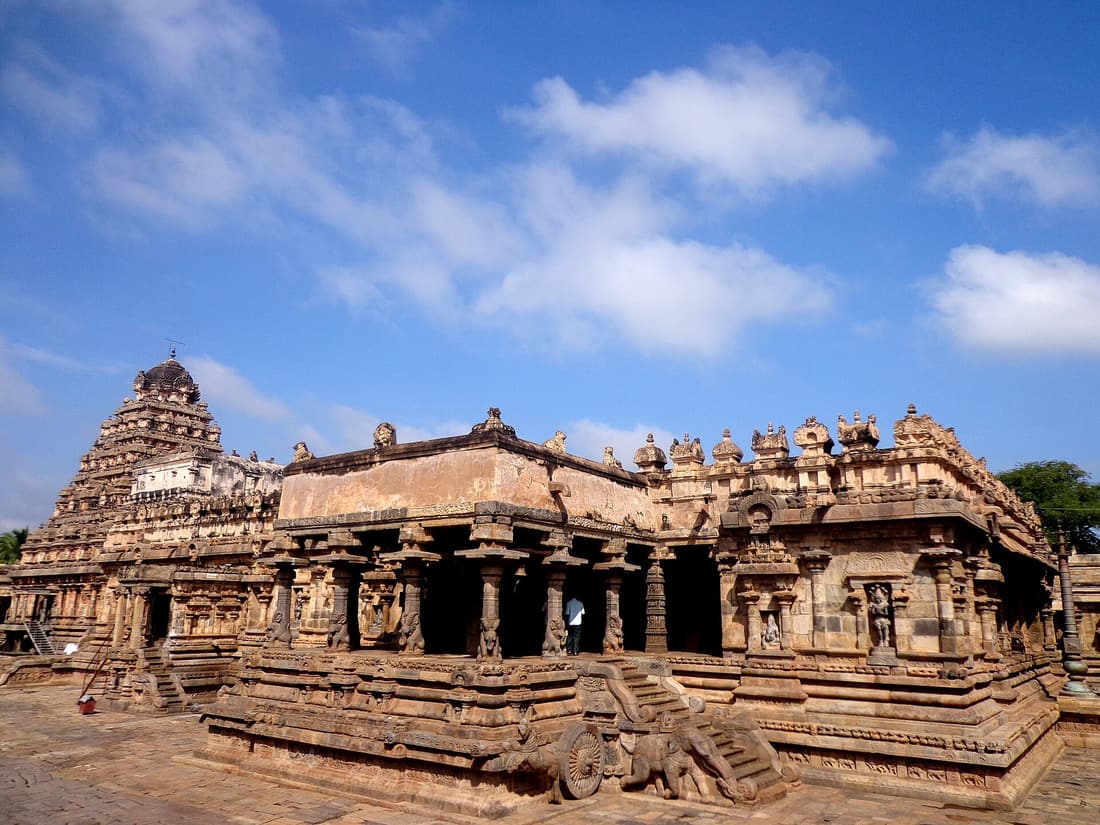
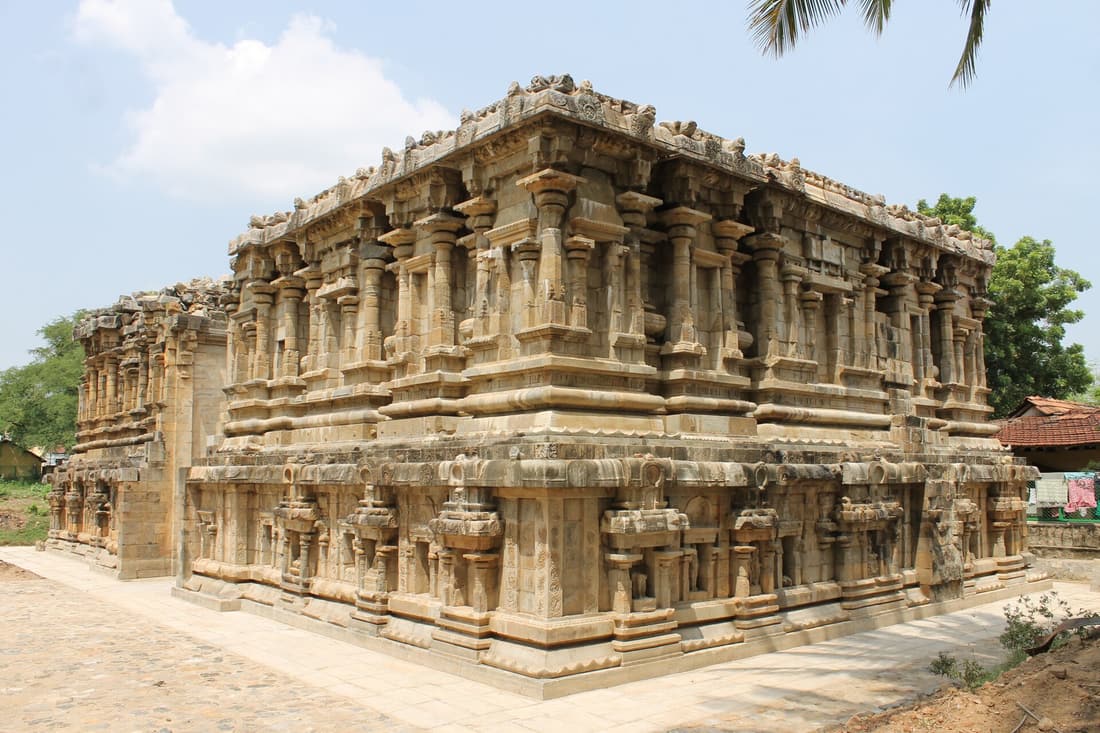
The temple stands on a square-plan compound about 107 m by 70 m, with a nandi mandapa and flagstaff outside it. The main temple sits on a plinth about 23 m by 63 m and includes the sanctum (garbhagriha) and three mandapas: the ardhamandapa, the mukhamandapa and the agramandapa. The vimana rises 24 m, and the sanctum is a square about 12 m on each side.[1]
The chariot mandapa
The front hall (agra mandapa), called Rajagambhiran-tiru-mandapam, is shaped like a chariot, with stone wheels and horses. The temple is classed as a karak koil because it was designed after a chariot. Wikipedia compares it with the Nritta-sabha at Chidambaram and the Konark Sun Temple; the TN Temples Project describes the mandapa as an elephant drawing a chariot.[1][2]
The singing steps
Near the bali-pitham, a porch about 7 m square has carved balustraded steps that are said to produce musical notes when struck. They are known as the singing steps.[1]
Sculpture
Reliefs along the base of the main temple narrate the lives of the 63 Shaiva saints (Nayanars), drawn from Sekkilar's Periya Purana. The outer walls of the sanctum have five niches on each side, with the middle one larger. The middle niche on each side shows a form of Shiva.[1]
The maha-mandapa is about 24 m by 18 m, with six rows of carved pillars (48 in all). Two large dvarapalas flank the ardhamandapa, and two sundials resembling chariot wheels are described in the lead of the article. Large stone slabs of the Saptamatrikas stand next to the Yama shrine.[1]
A separate shrine to the goddess stands north of the main temple. The TN Temples Project says it is a separate temple within the complex. A separate mandapa was built for Lord Sarabheshwarar, and some sculptures, including the story of Bhikshatanar and the rishi patnis, are now in the Thanjavur Museum.[1][2]
World Heritage status
The temple belongs to the UNESCO World Heritage Site Great Living Chola Temples. Wikipedia gives 1987 for the original inscription and 2004 for the extension that added this temple, but its text is not consistent on this point, so the year is flagged for checking against UNESCO's own page.being verified[1][3]
The three temples were built between the 10th and 12th centuries and share many similarities. Airavatesvara lies about 40 km north-east of Thanjavur's Brihadeeswara temple and about 30 km south-west of Gangaikonda Cholapuram.[1]
Wikipedia notes that Carl Sagan filmed at the temple for the Cosmos series (1980).[1]
Kumbakonam Pancha Krosha Sthalam
The temple is one of the five Kumbakonam Pancha Krosha Sthalams, where amritam is said to have fallen when Shiva, as a hunter, broke the pot. The others are Nageswarar at Tirunageswaram, Mahalingeswarar at Tiruvidaimaruthur, Swaminathar at Swamimalai and Sundareswarar at Koranattu Karuppur.[4]
Nearby temples
- Adi Kumbeswarar and Sarangapani temples in Kumbakonam, about 5 km away.[2][5]
- Swamimalai Murugan Temple and Tirunageswaram Naganathaswamy Temple, which belong to the same Pancha Krosha group.[4]
- Brihadeeswara Temple, Thanjavur, about 38-40 km away, and Gangaikondacholisvaram Temple, about 30 km away, complete the World Heritage group.[1][2]
How to reach
- The temple is on the outskirts of Kumbakonam, about 5 km away. Thanjavur is about 38 km, Mayiladuthurai about 42 km and Tiruvarur about 43 km.[2]
- The nearest airport is Tiruchirappalli, about 90 km away, and Chennai is about 310 km north-east.[1]
- The TN Temples Project suggests early mornings and the hour just before sunset, when the architecture stands out best.[2]
Festivals
Photos
Timings
- 7:00 to 12:00 and 5:00 to 8:00 — TN Temples Project [2]
- 8:00 AM to 12:30 PM and 4:00 PM to 7:30 PM — Savaari [6]
- 6:00 AM to 12:00 noon and 4:00 PM to 8:30 PM — TripXL [7]
Frequently asked questions
Who built the Airavatesvara Temple?
The Chola emperor Rajaraja II built it in the 12th century CE; Wikipedia gives the completion year as 1166 CE.[1][2]
What are the singing steps?
Carved balustraded steps near the bali-pitham that are said to produce musical notes when struck.[1]
Is it a UNESCO World Heritage Site?
Yes. It is part of the Great Living Chola Temples, together with the Brihadeeswara Temple at Thanjavur and the Gangaikondacholisvaram Temple at Gangaikonda Cholapuram.[1][3]
Why is it shaped like a chariot?
The front hall (Rajagambhiran-tiru-mandapam) is shaped like a chariot with stone wheels and horses, and the temple is classed as a karak koil because it was designed after a chariot.[1]
How far is it from Kumbakonam?
About 5 km, according to the TN Temples Project.[2]
Sources
- Airavatesvara Temple — WikipediaEncyclopedia (secondary) · accessed 2026-10-31
- Airavateswarar, Darasuram, Thanjavur — TN Temples ProjectTemple database (secondary) · accessed 2026-10-31
- Great Living Chola Temples — UNESCO World Heritage CentreOfficial (UNESCO) · accessed 2026-10-31
- Nageswarar, Tirunageswaram, Thanjavur — TN Temples ProjectTemple database (secondary) · accessed 2026-10-31
- Kumbakonam Adi Kumbeswarar Temple — Culture and HeritageTravel guide (unofficial) · accessed 2026-10-31
- Things to do in Darasuram — SavaariTravel listing (unofficial) · accessed 2026-10-31
- Airavatesvara Temple: A UNESCO World Heritage Site In Tamil Nadu — TripXLTravel listing (unofficial) · accessed 2026-10-31
Page last checked:
Suggest a correction by email