- Overview
- Legends
- Guru and Dakshinamoorthy
- Architecture and shrines
- The Pancha Aranya route
- How to reach
- Festivals
- Photos
- Timings
- Questions
- Sources
Overview
Apatsahayesvarar Temple at Alangudi is the Navagraha temple of Guru (Jupiter), though the Guru worshipped here is Shiva as Dakshinamoorthy on the south wall of the sanctum, not a separate planet shrine. The TN Temples Project says devotees crowd the Dakshinamurti shrine and largely ignore the main deity, and that the temple is always crowded on Thursdays.[2][3][1]
It is a Paadal Petra Sthalam sung by Sambandar and the first of the Pancha Aranya Kshetrams in the TN Temples Project listing (the shivatemples.com page places it fourth in the route), a group of five forest temples near Kumbakonam. Alangudi is also listed among the Parivara Sthalams.being verified[2][3]
Legends
The poison
When the ocean of milk was churned, the deadly Halahala poison emerged and Shiva drank it to protect the world. He is therefore called Abatsahayeswarar, the Lord as protector. The name Alangudi is derived from alan-kudi, the place where the alala (halahala) was drunk. The TN Temples Project also says Dakshinamoorthy taught the gods and sages who were stunned by the poison, and absorbed it.[2][1][3]
Sundarar and the boatman
Sundarar could not cross the river Vettaru during heavy floods. Shiva took the form of a boatman and ferried him across. When the boat hit a rock, Vinayaka ensured its safety, and he is worshipped as Kalangamal Kaththa Vinayagar. The TN Temples Project compares the flood story with the one at Tirukollampudur.[2][3]
Sundarar's image and the chicken pox marks
The image of Sundarar here shows chicken pox marks on its face. A king, impressed by Sundarar's beauty, wanted to take the image to Tiruvarur. The priest hid it in cloth as though carrying a sick child and told the soldiers it had chicken pox. By the next morning the image bore the marks.[2]
Parvati and Daksha
Parvati is said to have worshipped here as penance after attending her father Daksha's yagam, so that she could marry Shiva in her next birth. An image of Daksha with a goat's head is seen outside the main temple.[2]
The minister and the king
shivatemples.com says the temple was built by Amuthohar, a minister of King Musukanda Chakravarthy of Tiruvarur. The king asked him to share the merit of his devotion to Shiva; the minister refused and was beheaded. The king was later freed of the sin of killing a Brahmin by worshipping Aabatsakaayar here. Sage Viswamitra is also said to have worshipped here.[3]
Guru and Dakshinamoorthy
Alangudi is the Guru sthalam among the Kumbakonam Navagraha temples. Dakshinamurti stands on the south wall (koshta) of the sanctum, following the mata, pita, guru theme. The temple draws large crowds during the transit of Jupiter from one zodiac sign to another (Gurupeyarchi).[2][3]
The usual order of entry is the Amman shrine first, then the Shiva shrine, then Dakshinamoorthy on the south wall.[2]
Two other Guru shrines, at Thenkudithittai and Tiruvalidaayam, are also Paadal Petra Sthalams.[3]
Architecture and shrines
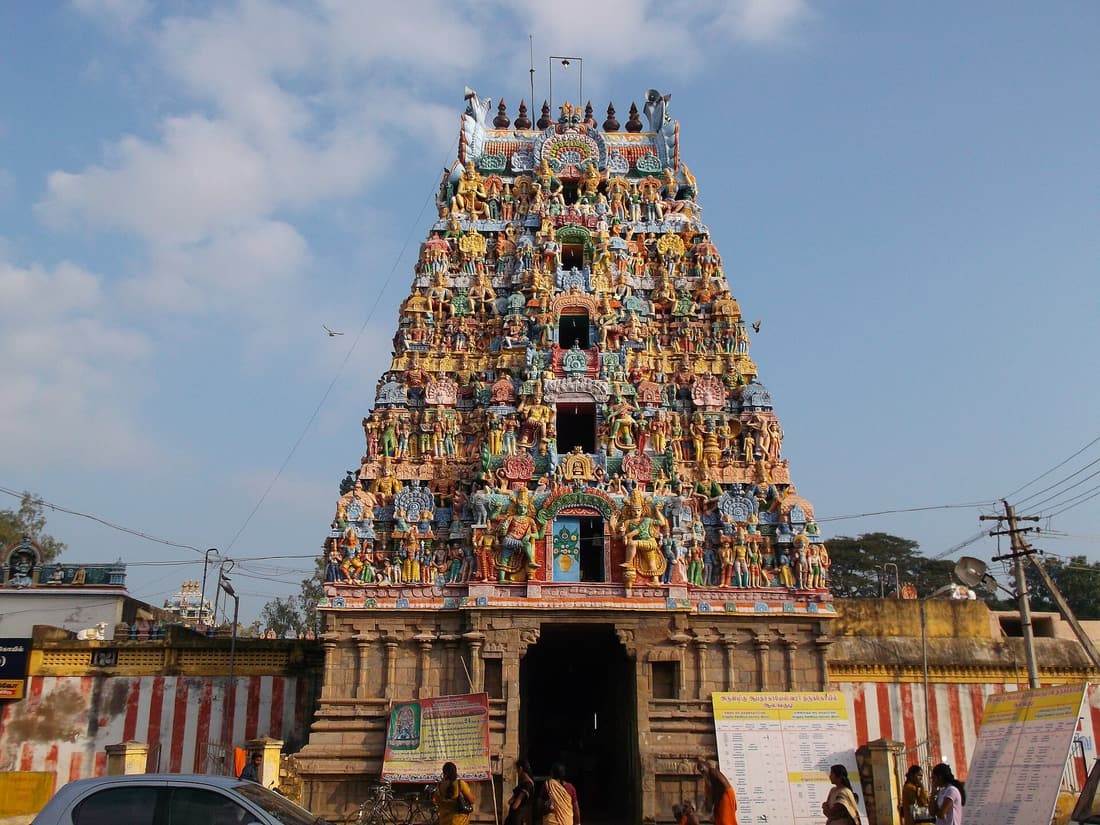
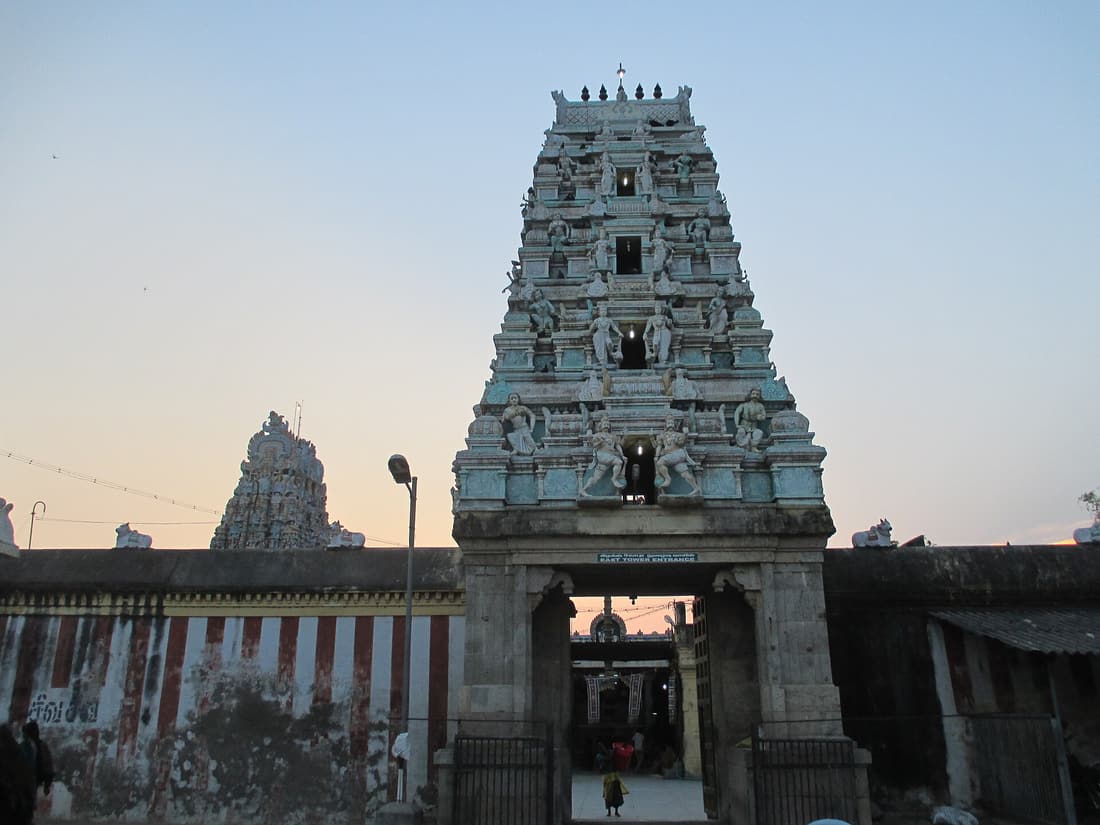
The temple covers about 1.25 acres and has high walls on all four sides. Wikipedia describes a five-tier rajagopuram, and says gopurams face the Apathsaheswarar shrine and the north.[3][1]
Shrines listed by shivatemples.com include Sooriyan, Somanathar, Saptarishi Nathar, Someswarar, Vishnunathar, Bhrameesar, Kaasi Viswanathar, Visalakshi, Dakshinamoorthy (Guru), whose shrine is outside the main sanctum, and a smaller Ganesha sanctum.[3]
The associated forest is Poolai Vanam, a forest of silk cotton trees; the page notes that none remain in the temple now.[3]
The Pancha Aranya route
The TN Temples Project suggests a one-day route through the five forest temples, with each temple's puja: Tirukarukavur (early morning), Avalivanallur (morning), Haridwaramangalam (midday), Alangudi (evening, Sayaratchai) and Tirukollampudur (night, Arthajamam). The total driving distance is about 36 km, which takes about 4-5 hours with visits.[2]
How to reach
- Alangudi is a small village on the Kumbakonam-Needamangalam road in Tiruvarur district, about 18 km south of Kumbakonam, 8 km north of Needamangalam and 21 km north of Mannargudi.[3]
- Distances on the TN Temples Project page: Kumbakonam 17.3 km, Tiruvarur 29.8 km, Thanjavur 37.6 km, Mayiladuthurai 47.1 km.[2]
Festivals
Photos
Timings
- 6:00 to 12:30 and 4:00 to 8:30 — TN Temples Project [2]
Frequently asked questions
Why do people visit Alangudi on Thursdays?
Thursday is the day of Guru (Jupiter), and the shrine of Dakshinamoorthy as Guru draws large crowds on that day.[2][3]
How did Alangudi get its name?
From alan-kudi, the place where Shiva drank the Halahala poison from the churning of the ocean.[2]
Who sang the hymns here?
Sambandar is listed as the Tevaram singer for this Paadal Petra Sthalam.[2][3]
Sources
- Apatsahayesvarar Temple, Alangudi — WikipediaEncyclopedia (secondary) · accessed 2026-10-31
- Abatsahayeswarar, Alangudi, Thanjavur — TN Temples ProjectTemple database (secondary) · accessed 2026-10-31
- Aabatsakaayeswarar temple, Tiru Erumpoolai — shivatemples.comTemple guide (Tevaram sites) · accessed 2026-10-31
Page last checked:
Suggest a correction by email