- Overview
- Legends
- History
- Architecture and shrines
- Worship
- Nearby Paadal Petra temples
- How to reach
- Festivals
- Photos
- Timings
- Questions
- Sources
Overview
Dharbaranyeswarar Temple at Thirunallar is the Navagraha temple of Shani, the planet Saturn. It stands in Karaikal district, part of the Union Territory of Puducherry, about 5 km west of Karaikal town. The main deity is Dharbaranyeswarar, Shiva as lord of the darbha grass forest, with his consort Praneswari Amman.[1][2]
It is a Paadal Petra Sthalam sung by Sambandar, Appar and Sundarar, and one of the Sapta Vitanga Sthalams, where Thyagaraja is worshipped as Thyagavidangar. The Sapta Vitanga lingam here is a maragatha (emerald) lingam, which the TN Temples Project says Muchukunda Chakravarti obtained after trials with Indra, representing the dance of an intoxicated person (Unmatha Natanam).[2][3]
The Shani shrine has its own sannidhi between those of Dharbaranyeswarar and the goddess. The zodiac signs Makara (Capricorn) and Kumbha (Aquarius) are shown in front, and the crow vahana is crafted in gold.[2]
Wikipedia says the Shani shrine is on the northern side of the entrance tower. The two sources describe different positions, so the location should be checked on arrival.being verified[1][2]
Legends
King Nala and Shani
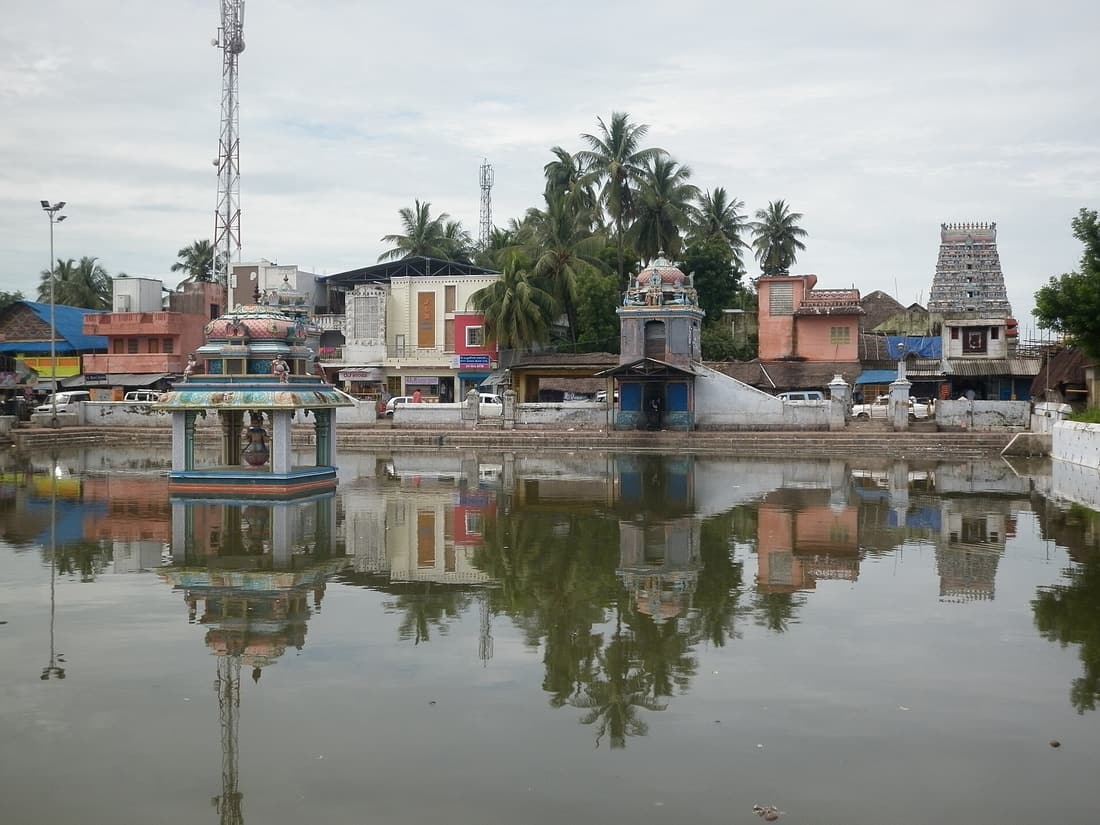
King Nala suffered under Saturn's adverse influence, lost his kingdom, wealth and wife, and was separated from his family. He bathed in Nala Theertham and worshipped Dharbaranyeswarar and Saneeswaran here, and regained his glory. The TN Temples Project says Shani released him at the temple threshold, and stays there to bless devotees. The temple walls carry paintings of Nala's life story.[1][2][3]
How Shani became Saneeswaran
Shani was born of Chaya, created by Suryan's wife Ushas, and was shunned by Suryan. He prayed to Viswanathar at Kasi and was accepted as one of the Navagrahas. Shivatemples.com adds that Shiva gave Shani the title Shaneeshwara after Shani told him that his seven-and-a-half-year period had already passed while Shiva was in seclusion.[3][2]
The Pachai Pathigam
Sambandar's hymn beginning Bhogamartha Poonmulaiyaal is known as the Pachai Pathigam (Green Hymn). By tradition, this hymn did not burn when manuscripts were placed in fire at Madurai before the Pandya king, in Sambandar's contest with the Jains, which led the king to embrace Shaivism.[2][3]
The shepherd and the Nandi
A shepherd who supplied milk to the temple was wrongly punished after an accountant diverted the milk. Shiva sent his trident to kill the accountant, and Nandi stepped aside to make way, which the pages say can still be seen in the bali pitham standing slightly off the flagstaff's axis.[3][1]
Other stories
A Kalinga king cursed by Sage Bhargava into a wild elephant was restored by a drop of water from a pilgrim who had bathed in the temple tank. By praying here, Vishnu and Mahalakshmi received Manmadhan as their son.[3]
History
Wikipedia says the present masonry structure was built during the Chola dynasty in the 9th century, with later expansions attributed to the Vijayanagar rulers. The pages reviewed mention no inscriptions.[1][3]
Architecture and shrines
Shivatemples.com describes a seven-tier rajagopuram, wide prakarams with high boundary walls, a front courtyard developed into a mandapam, and a Vasantha Mandapam used during festivals. Wikipedia says the rajagopuram has five tiers, so the number of tiers is flagged.being verified[2][1]
Shrines include Naleswarar, a lingam at the end of the inner prakaram believed to have been worshipped by Nala, Swarna Ganapathi as the Sthala Vinayaka, Subramanya, Adisesha, Nala Narayana Perumal, Mahalakshmi, Bhairava, and an Idaiyanar sannidhi on the southern side of the front courtyard. Wikipedia also lists a Somaskanda shrine and niches of Dakshinamurthy, Durga and Lingodbhava.[2][1]
Sundarar's shrine includes idols of the 63 Nayanmars.[2]
Worship
- Devotees apply sesame oil and bathe in the Nala Theertham before darshan of Saneeswaran, and wear black.[1][2]
- Common practices include lighting sesame oil lamps, feeding crows with til rice in the prakaram, and special poojas. Large crowds gather on Saturdays.[2]
- Shivatemples.com says six daily poojas are performed according to the Agamic rituals.[2]
- Devotees pray for relief from Sani dosham and for childbirth.[3]
Nearby Paadal Petra temples
- Distances from the temple on shivatemples.com: Tiru-Dharmapuram 4 km, Tiru-Theli-Cheri 5.2 km, Tiru-Kottaru 9.6 km, Tiru-Vetta-Kudi 12 km, Ambar Perum-Tiru-Kovil 15.2 km, Ambar-Maakaalam 16.9 km.[2]
How to reach
- The temple is about 5 km west of Karaikal and about 40 km from Mayiladuthurai on the route toward Nagapattinam. Karaikal is connected by road and rail, and local buses and auto-rickshaws run from Karaikal town.[2]
- Budget accommodation is available in Thirunallar, with budget and mid-range options in Karaikal, Mayiladuthurai and Tiruvarur.[3]
Festivals
Photos
Timings
- 6:00 to 12:00 and 4:00 to 9:00 — shivatemples.com [2]
- 6:00 to 12:30 and 4:00 to 9:00 — TN Temples Project [3]
Frequently asked questions
Is Thirunallar in Tamil Nadu?
No. It is in Karaikal district, part of the Union Territory of Puducherry, although it is one of the nine Navagraha temples near Kumbakonam.[1]
What is the Pachai Pathigam?
Sambandar's Tevaram hymn beginning Bhogamartha Poonmulaiyaal, which by tradition did not burn when placed in fire at Madurai.[2][3]
What do devotees do before darshan of Saneeswaran?
They apply sesame oil, bathe in the Nala Theertham and wear black, according to the sources.[1][2]
What is Shani Peyarchi?
The transit of Saturn, which happens about once every two and a half years and draws lakhs of devotees to the temple.[1][2]
How far is it from Kumbakonam?
About 55 km, according to the TN Temples Project.[3]
Sources
- Dharbaranyeswarar Temple — WikipediaEncyclopedia (secondary) · accessed 2026-10-31
- Dharbaranyeswarar temple, TiruNallaaru — shivatemples.comTemple guide (Tevaram sites) · accessed 2026-10-31
- Darbaranyeswarar, Tirunallar, Karaikal — TN Temples ProjectTemple database (secondary) · accessed 2026-10-31
Page last checked:
Suggest a correction by email