- Overview
- The Ketu shrine
- Legends
- History
- Architecture and shrines
- Worship and offerings
- How to reach
- Festivals
- Photos
- Timings
- Questions
- Sources
Overview
Naganathaswamy Temple at Keezhperumpallam, called the Kethu Sthalam, is the Navagraha temple of Ketu, in the Kaveri delta near Poompuhar. The main deity is Naganatha Swamy, Shiva, with his consort Soundarya Nayaki. Devotees come mainly to worship Ketu, though it is primarily a Shiva temple.[1][2][3]
The name Keezh-Perumpallam means the lower Perumpallam, because the place lies downstream on the Kaveri. Upstream is Mel-Perumpallam, home of the Valampura Nathar temple, a Paadal Petra Sthalam.[2]
The Ketu shrine
The Ketu shrine is in the first precinct and holds a black granite image. The TN Temples Project calls the shrine relatively new, and says Ketu is shown as a five-headed snake on a simha-peetham with folded hands. Dinamalar describes Ketu with a serpent head and human body, facing west on a lion seat with folded hands. The two descriptions differ.being verified[1][2][3]
There is no separate Navagraha shrine because this is a Ketu sthalam, but there are two Suryan images, one for Uttarayanam and one for Dakshinayanam, and a Saneeswaran image. Pujas to the two Suns follow the two Punyakala periods.[2][3]
Special pujas are performed for Ketu every day at Rahukalam and Yamakandam, which the TN Temples Project calls unusual. Ketu worship is observed on Mondays and on birth star days.[2][3]
Legends
Vasuki and the churning
During the churning of the ocean of milk, the serpent Vasuki served as the rope around Mount Mandara. Vasuki spat out the Halahala poison, which Shiva drank to protect the world. The devas and asuras threw Vasuki away, and he landed in a bamboo forest at this site. Vasuki prayed to Shiva for forgiveness, and Shiva stayed here as Naganathar at his request.[2][3][1]
How Ketu came to be
In a second account the asura Swarnabhanu joined the devas during the churning and was exposed by Suryan and Chandran. Vishnu, as Mohini, struck the asura's head. He survived because he had drunk amritam. His head became Rahu and his body, joined to a snake's head, became Ketu. Rahu and Ketu worshipped Shiva and were given a place among the Navagrahas: Rahu is enshrined at Tirunageswaram and Ketu is here.[2]
History
Appar refers to the temple in one of his pathigams, so the TN Temples Project concludes that a temple existed here before the 7th century. It dates the present structure to the 12th century (Chola period), while Wikipedia says the present masonry structure was built under the Nayaks in the 16th century. The pages mention no inscriptions.being verified[2][1]
Architecture and shrines
Wikipedia says the temple has a flat rajagopuram and is inconsistent about the enclosure, giving two prakarams in one place and a single prakaram in another. Other shrines include the Ambal (Sowndara Nayagi), Subramanya, Gajalakshmi, Bhairavar and Anugraha Vinayaka, which has its own shrine.being verified[1][2]
Worship and offerings
- Offerings to Ketu include multi-coloured cloth, horsegram (kollu), millet and red lilies. Dinamalar adds kollu rice (kollu sadham) as naivedyam and lamps lit with gingelly oil.[2][3]
- Devotees pray for relief from gastric and neurological troubles, for courage, progress in trade, family unity, prosperity and longevity. Those facing the adverse effects of Ketu pray first to Naganatha and then to Ketu with red flowers.[3]
- Pradosham is celebrated with great reverence because of the Halahala legend. Edible prasadam must be eaten within the temple premises and cannot be taken out.[2]
How to reach
- Dinamalar says the temple is 22 km from both Sirkali and Mayiladuthurai, that public transport runs only on Rahu-Ketu transition days, and that cabs can be hired from Mayiladuthurai. The nearest railway station is Mayiladuthurai and the nearest airport is Trichy.[3]
- The TN Temples Project lists Mayiladuthurai 29 km, Nagapattinam 52 km, Thiruvarur 58 km and Kumbakonam 66 km.[2]
Festivals
Photos
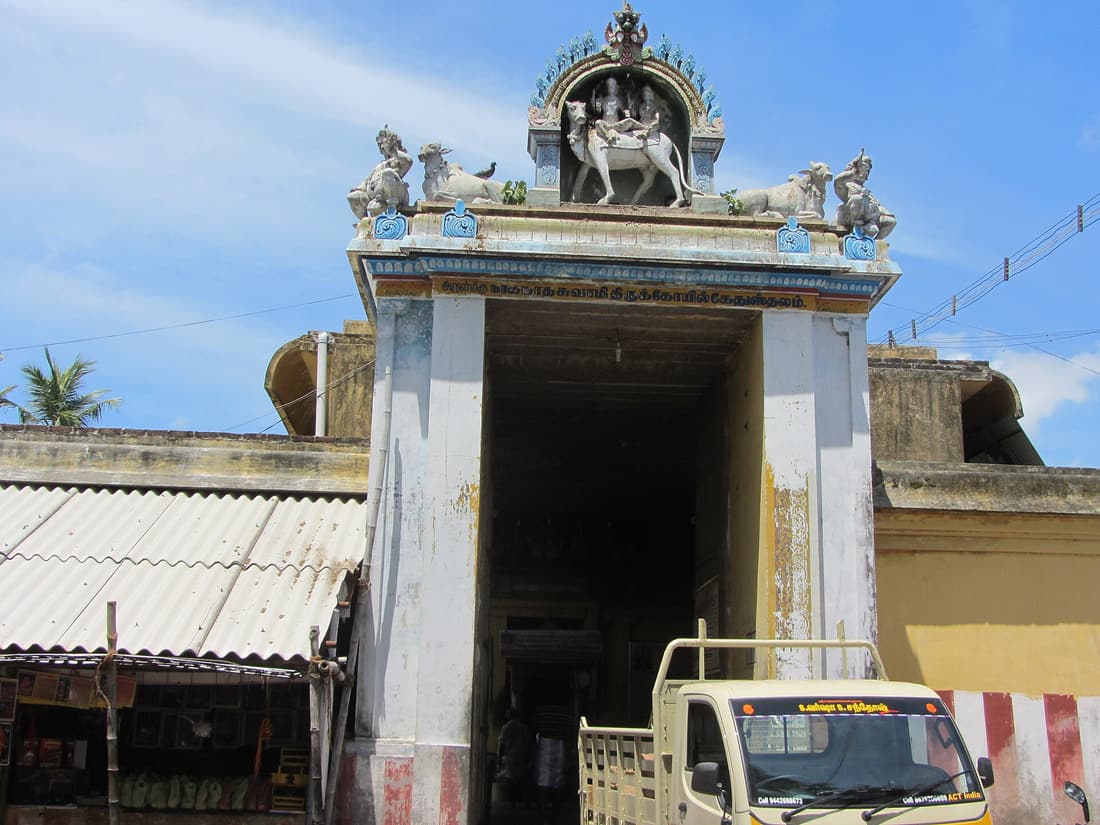
Timings
- 6:00 to 12:30 and 4:00 to 8:00 — TN Temples Project [2]
- 6:00 AM to 12:30 (listed as 'a.m.') and 3:30 PM to 8:30 PM — Dinamalar Temples [3]
Frequently asked questions
Why do people visit Keezhperumpallam?
It is the Navagraha temple of Ketu and a parihara sthalam for Ketu dosham, where special pujas are held every day during Rahu kalam and Yamakandam.[2][3]
What does Keezh-Perumpallam mean?
The lower Perumpallam, because it lies downstream on the Kaveri; upstream is Mel-Perumpallam.[2]
Is there a separate Navagraha shrine?
No. Because this is a Ketu sthalam there is no separate Navagraha shrine, but there are two Suryan images and a Saneeswaran image.[2][3]
Can prasadam be taken home?
The TN Temples Project says edible prasadam must be eaten within the temple premises.[2]
How do I get there?
Dinamalar says public transport runs only on Rahu-Ketu transition days and suggests hiring a cab from Mayiladuthurai, the nearest railway station.[3]
Sources
- Ketu stalam (Keezhperumpallam Naganathaswamy Temple) — WikipediaEncyclopedia (secondary) · accessed 2026-10-31
- Naganathar, Kilperumpallam, Nagapattinam — TN Temples ProjectTemple database (secondary) · accessed 2026-10-31
- Sri Naganathar Temple, Kilperumpallam — Dinamalar TemplesTemple guide (secondary) · accessed 2026-10-31
Page last checked:
Suggest a correction by email