- Overview
- Rahu with his two consorts
- Legends
- History
- Architecture and shrines
- Daily worship
- Nearby temples
- How to reach
- Festivals
- Photos
- Timings
- Questions
- Sources
Overview
Naganathaswamy Temple at Thirunageswaram, also called the Rahu Stalam, is the Navagraha temple of Rahu, about 5 to 6 km from Kumbakonam on the south bank of the Kaveri. The main deity is Naganatha Swamy, Shiva as lord of the serpents. Hindu tradition regards Rahu as a shadow planet that causes eclipses.[1][3][2]
The temple is a Paadal Petra Sthalam, one of the Kumbakonam Pancha Krosha Sthalams, and a sarpa dosha nivritti sthalam, a place for relief from snake-related afflictions. Dinamalar describes it as the 29th Shiva temple on the southern bank of the Kaveri.[2][3]
Sekkizhar, author of the Periya Puranam on the 63 Nayanmars, is said to have given its first recital here, and a Sekkizhar Vaikasi Pooja has been held since 1969.[2][1]
Rahu with his two consorts
The Rahu shrine is in the north-eastern part of the second prakaram. Unlike most temples, where Rahu appears with a snake body and a human head, here he appears in total human form, with his wives Simhi and Chitralekha.[2][3][1]
The temple is known for the belief that milk poured on Rahu during Rahu kalam turns blue. This is a belief reported by temple guides and has not been independently verified.[2][3][1]
Dinamalar says a milk abhishekam to Rahu is held between 4:30 PM and 6:00 PM on all Sundays. Wikipedia describes a separate Rahu abhishekam calendar with sessions at 11:30 AM and 5:30 PM and others at varying hours, so the schedule is not certain.being verified[3][1]
Rahu Peyarchi, the transit of Rahu to a new rasi, happens once every 1.5 years and is a major occasion.[1]
Legends
Serpents worship Shiva
Serpents including Adishesha, Takshaka and Karkotaka worshipped Shiva here, which gave the town its name. Adishesha did penance at Senbaranya Kshetram, named for its many Senbaga trees, and Shiva granted him a boon, hence the name Naganathar. Takshaka, cursed to be born human after biting Sukarma, the son of a sage, installed a lingam here on Sage Kashyapa's advice and was freed.[1][2]
Rahu settles here
After hearing these events, Rahu is said to have decided this would be the safest place for him and settled here permanently with his wives. Wikipedia's local legend says Rahu was relieved of his suffering by praying to Naganathar on a Shivaratri day.[2][1]
Four temples on Shivaratri night
The TN Temples Project says Nagaraja worshipped Shiva at four temples through the four jamams of Maha Shivaratri night: Nageswarar at Kumbakonam, Nageswarar at Tirunageswaram, Seshapureeswarar at Tirupampuram and Naganathar at Nagore.[2]
Girigujambigai and Indra
Indra worshipped Giri Gujambigai with a scented material called punugu for 45 days to escape the curse of Sage Gautama. The TN Temples Project says Girigujambigai Amman is a swayambhu murti, so no abhishekam is performed on her image; Wikipedia's ritual section describes abhishekam for the goddess, and the difference is noted.being verified[1][2]
History
The temple is believed to have been built by Aditya Chola I in the 10th century, in the Chola style, and later Cholas made additions. Wikipedia says the Nayak-period ornamental entrance hall with yali pillars was built by Govinda Dikshitar, minister to Achuthappa Nayak (1560-1614) and Raghunatha Nayak (1600-34). The western walls were renovated in 1929.[1][2]
A Ganapathy shrine at the eastern end contains a Ganapathy yantram said to have been installed by Sadasiva Brahmendrar.[2][1]
Architecture and shrines
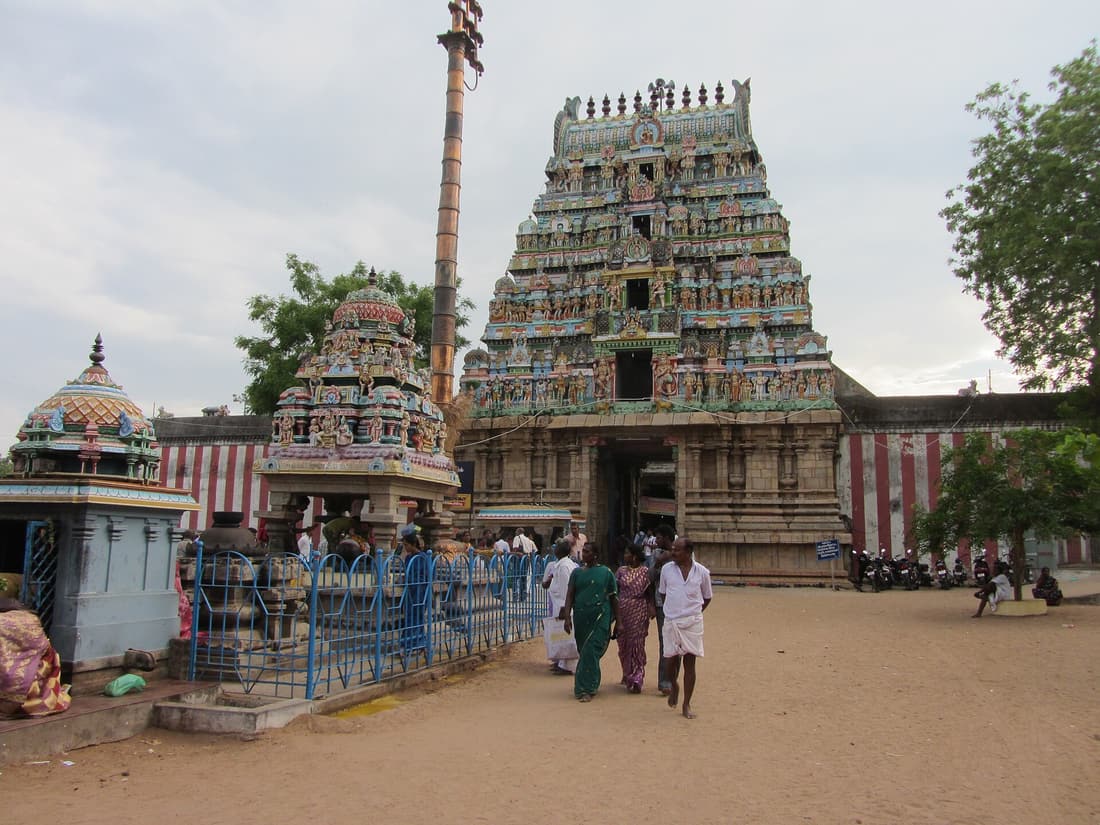
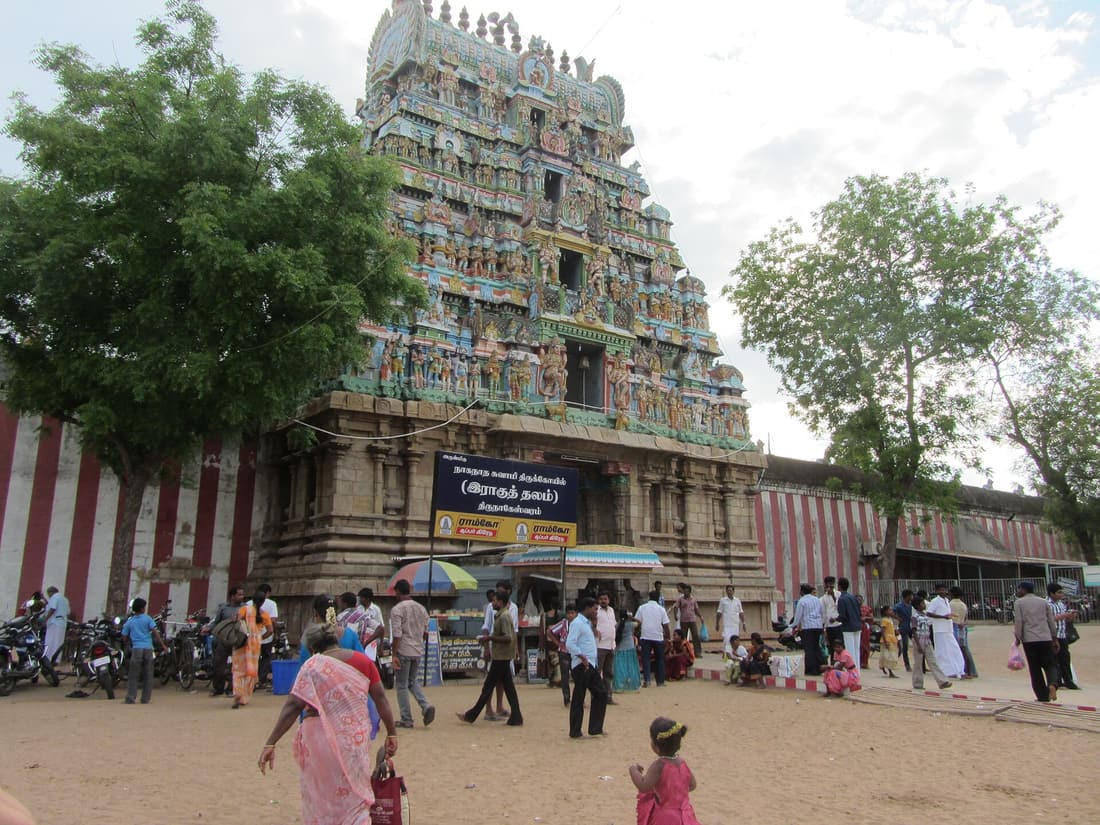
The temple has four gateway towers, one on each side, and covers about 630 ft (190 m) from south to north and 800 ft (240 m) from east to west. The second precinct has a granite floor, and the third has a broad pathway with a flower garden on the north side.[1]
On entering from the eastern entrance, the Devi sub-complex is on the right (north). There Amman, Lakshmi and Saraswati are enshrined together, which the TN Temples Project calls a very rare depiction, guarded by Maha Bhairavar. Dinamalar says the three Mothers Girigujambikai, Mahalakshmi and Saraswathi grace from a single shrine.[2][3]
A hall of a hundred pillars stands beside the tank on the south side. The Sula Theertham is believed to clear sins when bathed in.[1]
Daily worship
Wikipedia lists six daily poojas: Ushathkalam 6:00 AM, Kalasanthi 9:00 AM, Uchikalam 1:00 PM, Sayarakshai 5:00 PM, Irandamkalam 7:00 PM and Ardha Jamam 9:00 PM. The article is inconsistent about some of the deity names in this passage, so the times are indicative only.being verified[1]
Monthly observances include amavasai, kiruthigai, pournami and sathurthi; pradosham is fortnightly, and somavaram and sukravaram weekly.[1]
Wikipedia also describes a remedy for Rahu-Ketu dosha of worshipping at Kudanthai in the morning, Thirunageshwaram at noon, Thirupamburam in the evening and Nagoor at night.[1]
Nearby temples
How to reach
- Tirunageswaram is 6 km east of Kumbakonam, with bus service from Kumbakonam. The nearest railway station is Kumbakonam and the nearest airport is Trichy.[3]
- Distances from the TN Temples Project: Kumbakonam 6 km, Mayiladuthurai 33 km, Tiruvarur 37 km, Thanjavur 47 km. Wikipedia gives both 5 km and 7 km from Kumbakonam in different passages.[2][1]
Festivals
Photos
Timings
- 6:00 AM to 12:45 PM and 4:00 PM to 8:30 PM — Dinamalar Temples [3]
- 6:00 to 12:30 and 4:00 to 8:30 — TN Temples Project [2]
Frequently asked questions
Why do people visit Thirunageswaram?
It is the Navagraha temple of Rahu and a place for relief from snake-related (sarpa) dosha.[2][1]
Does the milk really turn blue?
Temple guides report a belief that milk offered to Rahu during Rahu kalam turns blue. This has not been independently verified.[2][3]
What is special about the Rahu image here?
Rahu appears in total human form with his wives Simhi and Chitralekha, whereas in most temples he is shown with a human head and snake body.[2][3]
Which Tevaram saints sang here?
Sambandar, Appar and Sundarar, according to the TN Temples Project.[2]
Sources
- Rahu stalam (Tirunageswaram Naganathar Temple) — WikipediaEncyclopedia (secondary) · accessed 2026-10-31
- Nageswarar, Tirunageswaram, Thanjavur — TN Temples ProjectTemple database (secondary) · accessed 2026-10-31
- Sri Nageswarar Temple, Tirunageswaram — Dinamalar TemplesTemple guide (secondary) · accessed 2026-10-31
Page last checked:
Suggest a correction by email