- Overview
- Legends
- History
- Architecture and the chariot sanctum
- Worship and customs
- Alvar hymns
- Link with the Mahamaham
- Nearby temples
- How to reach
- Festivals
- Photos
- Timings
- Questions
- Sources
Overview
Sarangapani Temple is the largest Vishnu temple in Kumbakonam and has the town's tallest temple tower. The presiding deity is Sharngapani, the Lord who holds the Sarnga bow, shown reclining. He is also called Aravamudhan. His consort is Komalavalli Thayar.[1][2]
The temple is one of the 108 Divya Desams, the Vishnu temples praised by the twelve Alvars in the Nalayira Divya Prabandham. It is counted among the Pancharanga Kshetrams on the Kaveri, and among the Pancha Kshethram group associated with the legend of Lakshmi's birth.[1]
The sanctum is built in the form of a chariot drawn by horses and elephants. Because it imitates the processional chariots used in festivals, the temple is classed as a karakkoil.[1][2]
Legends
How Komalavalli was born
The sage Bhrigu tested the Trimurti to find which was supreme. He kicked Vishnu on the chest, and Vishnu did not respond in anger. Lakshmi, who lives on that chest, was displeased and left Vaikuntha. Bhrigu then asked that Lakshmi be born as his daughter, and in a later life, as the sage Hemarishi, he performed penance beside the Potramarai tank.[1][2]
Lakshmi appeared from the tank among a thousand lotuses and was named Komalavalli, meaning the one who emerged from a lotus. Vishnu came from Vaikuntha as Aravamudhan in a chariot drawn by horses and elephants, stayed at the nearby Someswaran temple, and married her. The temple therefore calls itself the Avatara Sthala, the birthplace of Komalavalli.[1][2]
Pathala Srinivasa
To avoid Lakshmi's anger, Vishnu is said to have stayed in an underground chamber of the temple as Pathala Srinivasa. The Dinamalar listing describes the Pathala Srinivasa shrine as marking the place where the Lord hid underground before the wedding.[1][2]
Why the Lord is only half risen
Tirumalisai Alvar asked Aravamudhan whether he was resting because his legs hurt, and asked him to rise. The image began to rise to a giant size, and the Alvar asked him to recline again. The Lord stopped midway, which gives the posture called Uthana Sayi (the half-waking pose).[1][2]
Nathamuni and the Divya Prabandham
Nathamuni heard only ten verses sung here by devotees and sought the rest. The Lord appeared to him in a dream and sent him to Alvar Tirunagari, where Nammalvar gave him the 4,000 verses. For this reason the Lord is also praised as Aravamudha Azhwar.[2][1]
The Deepavali rite
A devotee named Lakshmi Narayanaswami served the Lord all his life and is said to have built the rajagopuram. Childless, he attained the Lord's feet on a Deepavali day, and the Lord is said to have performed his last rites. The event is re-enacted every year during the midday puja on Deepavali, which devotees cannot watch. Wikipedia describes it as unique, because death rites are performed inside a Vishnu temple.[2][1]
History
A Vaishnava settlement may have existed here by the 7th or 8th century, and early Chola oral traditions mention the temple. The earliest epigraphic evidence dates to the late Chola period (10th-12th centuries). The original shrine no longer survives because of later rebuilding.[1]
The Vijayanagara and Nayaka rulers (15th-17th centuries) expanded the structure, in contrast to the Cholas' focus on Shaiva temples in Kumbakonam. The town has three main Vaishnava temples from this period: Sarangapani, the Ramaswamy Temple and the Chakrapani Temple. A Vaishnava matha became associated with the temple in the 17th century under the Nayakas.[1]
The most recent consecration (Mahasamprokshanam) recorded by Wikipedia took place on 13 July 2015. The citation attached to that date does not match, so the date is flagged for checking.being verified[1]
Architecture and the chariot sanctum
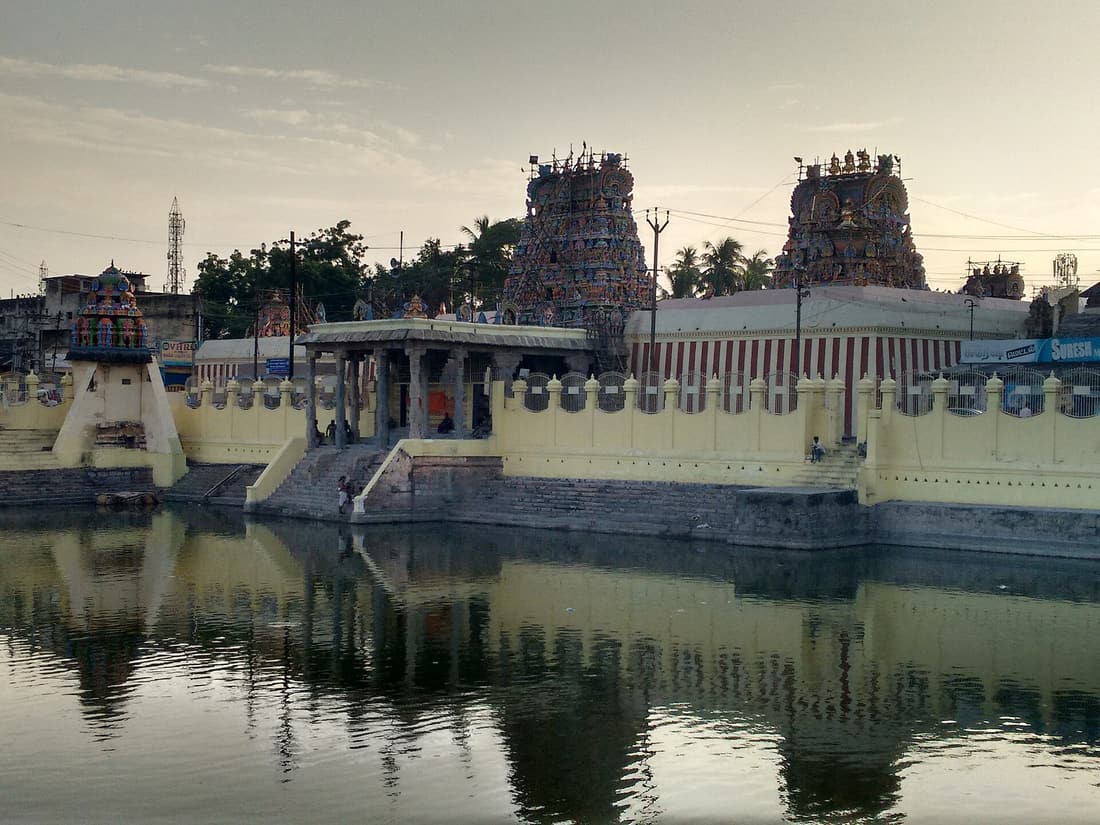
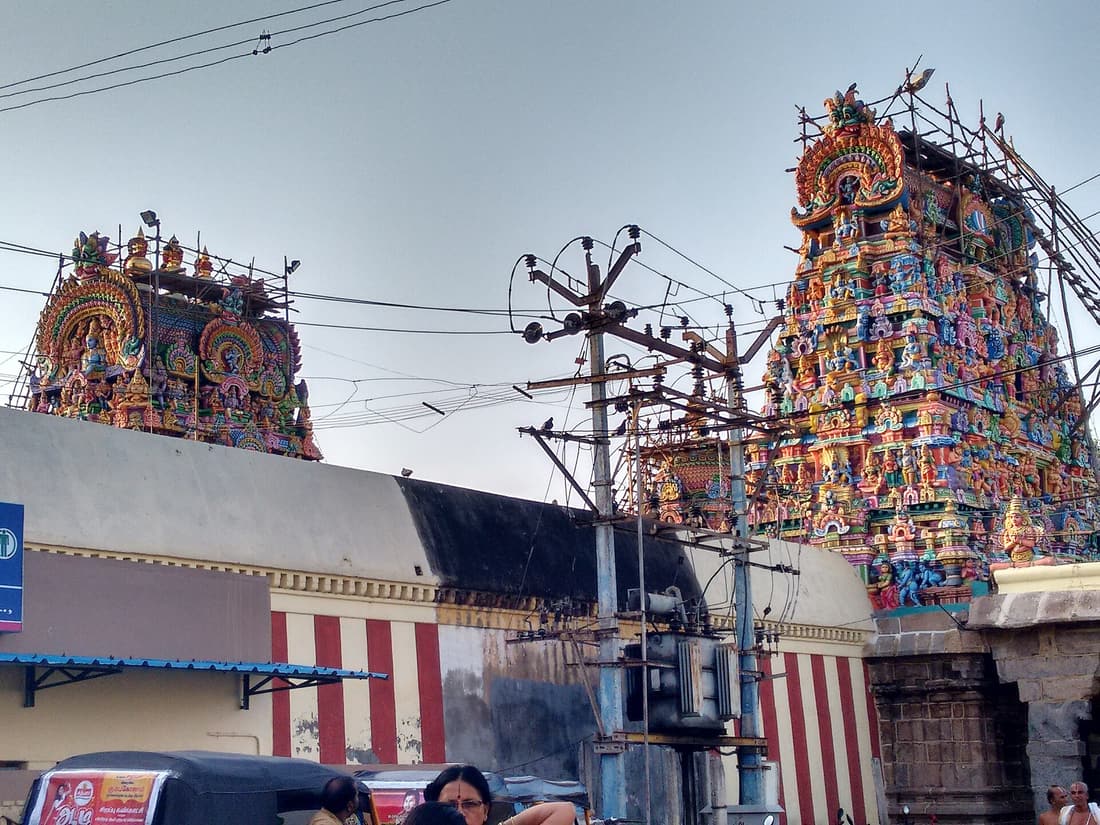
The temple faces east inside a huge wall. The rajagopuram has eleven tiers and carvings of religious stories, and five smaller gopurams stand elsewhere in the complex. Wikipedia gives the height as 173 ft (53 m), while Dinamalar says 150 ft and calls it the third tallest tower in Tamil Nadu after Srirangam (236 ft) and Srivilliputhur (165 ft). Because the figures conflict, no single height is certain.being verified[1][2]
The sanctum is reached through a 100-pillared hall. A perforated window lies on the axis of the sanctum and can be seen from the outer entrance. The sanctum has two stepped entrances, the Uttarayana Vaasal and the Dakshinayana Vaasal; only one is open at a time.[1][2]
According to Wikipedia, the Uttarayana door is open from 15 January to 15 July and the Dakshinayana door during the other half of the year. Dinamalar describes the same practice as Thai to Aani for the Uttarayana gate and Aadi to Margazhi for the Dakshinayana gate. Unlike most Divya Desams, this temple has no Sorgavasal (heaven's door) opening on Vaikunta Ekadasi, since the Lord is said to have come directly from Vaikuntha; passing through the two gates is believed to be equivalent.[1][2]
The temple has two wooden processional chariots outside the rajagopuram. Dinamalar calls the temple's car Chithira Ther and says Tirumangai Alvar called the chariot form Rathabandham. Wikipedia notes that several of the 108 Bharatanatyam karanas are sculpted on the walls.[1][2]
Sculptures of the Narasimha avatar surround the sanctum. Dinamalar says Brahma is shown above the Lord's navel and the Sun at the head end. The Lord holds the discus, the conch and the Sarnga bow, which is not visible in the presiding image.[2]
Worship and customs
- Mother first: worship begins with the Thayar, who is treated as dominant. The Go-puja (cow worship) is done at the Komalavalli Thayar shrine before the Lord's pujas. The Lord is described as staying in his mother-in-law's house.[2]
- Ubaya Pradhana Kshetram: the main image and the festival image (utsavar) hold equal importance, and pujas and alankarams are offered to the utsavar acting on behalf of the main deity.[2][1]
- Santhanakrishna shrine: located before the sanctum, where devotees pray for the fulfilment of wishes. Thanksgiving is made with Tirumanjanam and offerings of clothes.[2]
- Thiruvelukkutrirukkai: Thirumangai Alvar's single verse of 46 lines, which forms the image of a temple chariot when read in numerical order, is painted in the temple. Wikipedia says it is believed that Thirumangai Alvar himself instituted the first temple chariot.[1]
Alvar hymns
The temple is praised by seven Alvars. Wikipedia lists their verses as Andal (1), Periyalvar (3), Bhuthath Alvar (2), Tirumalisai Alvar (7), Peyalvar (2), Nammalvar (11) and Thirumangai Alvar (25), which totals 51 verses.[1]
Dinamalar lists a wider set of Alvars who sang of the Lord, including Poigai, Madhurakavi, Kulasekhara, Tirupanazhwar, Thondaradipodi, Peyazhwar, Bhoodhathazhwar, Tirumazhisai, Nammazhwar, Periazhwar and Andal. The two lists differ, so the Wikipedia list of seven is used for counts.being verified[2]
Link with the Mahamaham
Five Vishnu temples in Kumbakonam are linked with the Mahamaham festival, held once every twelve years: Sarangapani, Chakrapani, Ramaswamy, Rajagopalaswamy and Varahaperumal. The Potramarai tank lies outside the western entrance of this temple.[1]
Nearby temples
- Adi Kumbeswarar Temple, the oldest Shiva temple in Kumbakonam, is separated from this temple by the Potramarai tank.[4]
- Chakrapani and Ramaswamy temples, the other two main Vaishnava temples of Kumbakonam.[1]
- Dinamalar's nearby-temples tab lists Andalakkum Aiyan, Padikasu Nathar, Gajendra Varadhan, Hara Shaba Vimochana Perumal, Appakudathan and Adhivaraha Perumal.[2]
How to reach
Festivals
Photos
Timings
- 7:00 AM to 12:00 noon and 5:00 PM to 9:00 PM — Dinamalar Temples [2]
- 6:00 AM to 12:00 noon and 5:00 PM to 9:00 PM — Divine Traveller [3]
Frequently asked questions
Why is the temple shaped like a chariot?
The sanctum is designed as a chariot drawn by horses and elephants, recalling the Lord's descent from Vaikuntha. It is classed as a karakkoil, a temple modelled on the processional chariots used in festivals.[1][2]
Which door is open at which time of year?
The Uttarayana door is open from Thai to Aani (mid-January to mid-July) and the Dakshinayana door for the rest of the year; only one is open at a time.[1][2]
Is there a Sorgavasal on Vaikunta Ekadasi?
No. Dinamalar says the temple has no Sorgavasal opening because the Lord is believed to have come directly from Vaikuntha.[2]
How tall is the rajagopuram?
It has eleven tiers. Wikipedia gives 173 ft (53 m) and Dinamalar gives 150 ft, so the exact height is unconfirmed.[1][2]
What is the temple phone number?
Dinamalar lists +91-435-243 0349 and 94435 24529. Please check before relying on it.[2]
Sources
- Sarangapani Temple — WikipediaEncyclopedia (secondary) · accessed 2026-10-31
- Sri Sarangapani Temple, Kumbakonam — Dinamalar TemplesTemple guide (secondary) · accessed 2026-10-31
- Sarangapani Temple, Kumbakonam — Divine TravellerTravel blog (unofficial) · accessed 2026-10-31
- Aadi Kumbeswarar, Kumbakonam, Thanjavur — TN Temples ProjectTemple database (secondary) · accessed 2026-10-31
Page last checked:
Suggest a correction by email