- Overview
- Legend
- History and inscriptions
- How to worship: the prescribed order
- Architecture and shrines
- How many Sun temples are there?
- Nearby temples
- How to reach
- Festivals
- Photos
- Timings
- Questions
- Sources
Overview
Suryanar Koil is the temple of Surya, the Sun god, near Aduthurai in Thanjavur district. It is the first of the Kumbakonam Navagraha temples, because Surya is regarded as the most important of the nine planets.[2][1]
The Sun god faces west and holds a lotus in each hand, with his consorts Ushadevi and Pratyusha Devi on either side. The Sun's horse stands before him, where Nandi would normally stand before Shiva.[3][2]
Unlike most Navagraha shrines, all eight other planets have their own separate shrines here, and the TN Temples Project says this may be the only such layout in Tamil Nadu. The planets are shown as anugraha murtis, without weapons or vehicles.[2][1][3]
Guru (Jupiter) stands on the axial line facing the Sun. The temple listing says this is to ease the heat of the Sun for worshippers.[3][2]
Legend
The sage Kalava (Galva), who was to suffer from leprosy, prayed to the Navagrahas, who cured or protected him. Brahma resented this, believing he alone controlled human destiny, and cursed the planets with leprosy and to be sent to earth, to Vellurukku Vanam, a jungle of white wild flowers.[1][2][3]
The TN Temples Project adds that Vinayakar guided the planets to Prananatheswarar at Tirumangalakudi, and that Shiva there relieved them of the curse and blessed them to be present as anugraha murtis in a nearby temple that Sage Kalava would build. That temple is Suryanar Koil, which is regarded as the Navagraha shrine of the Tirumangalakudi temple and visited together with it.[2]
Both the TN Temples Project and Dinamalar mention the Sun temple at Poompuhar (Uchikizhan Kottam), from the Sangam age, which was destroyed by a tsunami; Dinamalar says that this temple survived.[2][3]
History and inscriptions
The temple was built under Kulottunga Chola I, in the late 11th and early 12th century, in the Chola (Dravidian) style. An inscription in the temple calls it Kulottunga Chola Marthandalayam, and inscriptions also record grants and endowments by Krishna Deva Raya. Later additions were made in the Vijayanagara period.[1][2]
It is a Tevaram Vaippu Sthalam. The TN Temples Project names no hymns and no singers.[2]
How to worship: the prescribed order
The TN Temples Project describes a particular order of worship and advises visiting the Prananatheswarar temple at Tirumangalakudi first.[2]
Start with Kol Vinai Teertha Vinayakar in the south-east corner, then worship Viswanathar and Visalakshi in the main shrine, then Suryan in the sanctum, then Guru who faces Suryan.[2]
Leave the mandapam by the right side and walk around the rear of the sanctum to Chandikeswarar. From there go clockwise through the shrines of Rahu, Sukran, Ketu, Chandran, Sevvaai (Mars), Budhan and Sani. Finish with a prostration (namaskaram) at the flagstaff, facing north.[2]
Thala Vasam and remedies
Dinamalar describes devotees who stay for 12 Sundays (about 78 days), called Thala Vasam, starting from the first Sunday morning. During the stay they bathe in the nine theerthams, fast, and worship Prananatha at Tirumangalakudi, Mangala Nayaki and other deities. They seek relief from adverse planetary effects, especially during Saturn's seven-and-a-half-year period, Saturn in the 8th or birth sign, or Sun main or sub-periods.[3]
Offerings include sarkarai pongal (called very important here), Nadi Pariharam, Navagraha homas, Surya archana, tulabaram (offering wheat, jaggery or farm produce equal to one's weight) and cradles for those seeking a child.[3]
Architecture and shrines
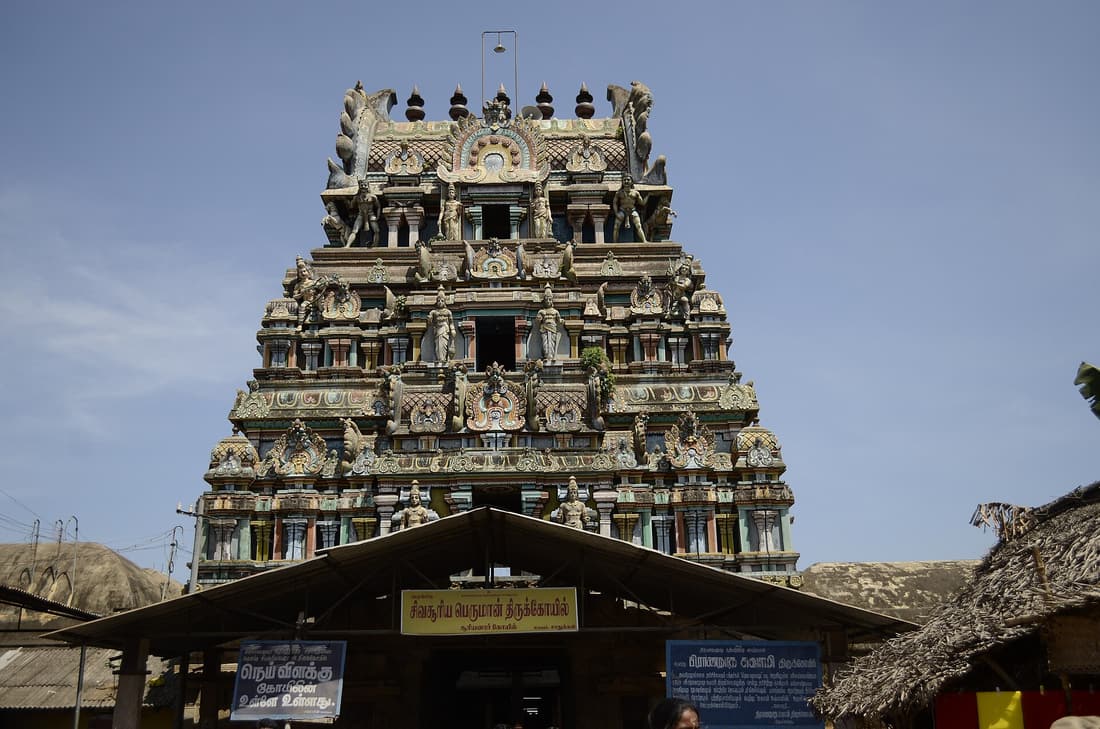
A five-tiered rajagopuram leads into a complex enclosed by a granite wall. The temple and the sanctum face west, which is unusual, since the Sun is normally shown facing east.[1][2]
Hall shrines include Viswanathar, Visalakshi, Nataraja, Sivakami, Vinayagar and Murugan. Separate shrines stand for Budha, Shani, Sukran, Soma, Angaragan, Rahu and Ketu.[1]
How many Sun temples are there?
Dinamalar says this is one of only two Sun god temples in India, the other being at Konark. The TN Temples Project calls that claim untrue and lists four ancient Sun temples, one in each direction: Marthand (Kashmir), Modhera (Gujarat), Konark (Odisha) and Marthandam (near Kanyakumari).being verified[3][2]
Nearby temples
How to reach
- By bus: buses run from Kumbakonam, Mayiladuthurai, Aduthurai and Anaikarai-Tirupanandal. Get off at the Tirumangalakudi Kaliamman temple stop; the temple is about two furlongs away.[3]
- The nearest railway stations are Aduthurai, Kumbakonam and Mayiladuthurai, and the nearest airport is Tiruchi.[3]
- Distances listed on the TN Temples Project page: Kumbakonam 16 km, Mayiladuthurai 22 km, Tiruvarur 40 km, Ariyalur 57 km.[2]
Festivals
Photos
Timings
- 6:00 AM to 12:30 PM and 4:00 PM to 8:00 PM — TN Temples Project [2]
- 6:00 AM to 11:00 AM and 4:00 PM to 8:00 PM — Dinamalar Temples [3]
Frequently asked questions
Which planet is worshipped at Suryanar Koil?
Surya, the Sun. It is the first temple of the Kumbakonam Navagraha circuit.[2][1]
Which temple should be visited before Suryanar Koil?
The TN Temples Project advises visiting the Prananatheswarar temple at Tirumangalakudi first, since this temple is regarded as its Navagraha shrine.[2]
What is Thala Vasam?
A stay of 12 Sundays (about 78 days) described by Dinamalar, during which devotees bathe in the temple's theerthams, fast and worship, seeking relief from planetary afflictions.[3]
Sources
- Suryanar Kovil — WikipediaEncyclopedia (secondary) · accessed 2026-10-31
- Viswanathar / Suryan, Suryanar Koil, Thanjavur — TN Temples ProjectTemple database (secondary) · accessed 2026-10-31
- Sri Suriyanar Temple, Suriyanarkoil — Dinamalar TemplesTemple guide (secondary) · accessed 2026-10-31
Page last checked:
Suggest a correction by email